
Lunch and Learn Series
The Center for Precision Medicine and Data Sciences (CPMDS) proposes a six-session Luncheon Learn Series to be offered during the winter and spring terms. The series is designed to build foundational literacy in clinical data, omics, and artificial intelligence, while highlighting UC Davis–specific resources that enable translational precision medicine research.
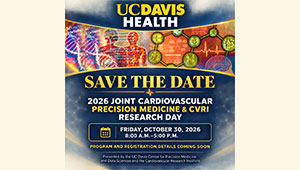
Join us on Friday, Oct. 30, 2026, for a full day of cardiovascular research, precision medicine, collaboration, and scientific exchange at Aggie Square.
Learn More2026 Summer Intern Program

The 2026 UC Davis Health Summer Internship Program in Precision Medicine and Data Sciences welcomed high school and undergraduate students for an immersive, four-week exploration of the rapidly evolving intersection of biology, medicine and computation. Through hands-on coding, guided workshops and collaborative projects, participants built practical skills across molecular modeling, pharmacology, multiscale physiology, data science and artificial intelligence—learning how integrated approaches can help address complex biomedical challenges.

Students applied these skills to real-world research experiences, from simulating cardiac activity and examining how genetic variation affects protein function to using AI tools such as AlphaFold for protein structure prediction and exploring the design of targeted therapeutics. More than a summer internship, the program encouraged curiosity, collaboration and confidence across disciplines, empowering participants to see themselves as future contributors to precision medicine and data-enabled health care.
Optical Digital Twins for Disease Prevention, Diagnosis, Therapy, and Intervention

Optical digital twins are opening new possibilities for disease prevention, diagnosis and personalized treatment.
A new perspective article, “Optical Digital Twins for Disease Prevention, Diagnosis, Therapy, and Intervention,” explores how advanced optical technologies, computational modeling and artificial intelligence could help transform the future of health care.
We are proud to highlight Colleen Clancy, Director of the UC Davis Center for Precision Medicine and Data Sciences, as a co-author of this forward-looking publication.
Clancy’s work continues to advance bold, interdisciplinary approaches that connect complex biological data with meaningful clinical insight. Optical digital twins hold exciting potential to deepen our understanding of disease, improve diagnosis, guide treatment and support more individualized interventions.
Congratulations to Director Clancy and her collaborators on helping shape this rapidly emerging frontier in precision medicine!
BoltzOmics: Predicting genetic variant effects on drug binding with Boltz-2
July 2026
Summary
A mechanistic understanding of how genetic variants alter drug-receptor binding is central to precision medicine, drug response prediction, and drug development. Yet, experimental mutation-drug profiling remains slow and expensive, while existing computational approaches often trade accuracy for scalability. We developed BoltzOmics, an interactive, open-source platform that integrates Boltz-2, a deep learning model for biomolecular structure prediction, to rapidly assess mutation effects on drug binding. Starting from amino acid sequences, the workflow queries databases for genetic variants, generates wild-type and mutant protein structures, and screens multiple drugs across variants to predict binding affinity changes. We evaluated BoltzOmics across four targets: hERG, NaV1.5, HER2, and CYP3A4. Predictions achieved Pearson correlations with experimental drug IC50 data up to 0.76 for wild-type proteins and 0.60 for mutants. By enabling scalable, high-throughput assessment of drug-variant interactions, BoltzOmics establishes a practical AI-driven framework for accelerating computational drug discovery and advancing precision medicine research.
From Lipid Dynamics to Precision Predictions: A New Approach Methodology for Precision Modeling of Phosphoinositide Signaling
July 2026
Abstract
Precision medicine requires models that can translate rich molecular measurements into individualized predictions of biological response. This challenge is particularly acute for phosphoinositide signaling disorders that often exhibit cell-type-specific responses to identical genetic or pharmacological perturbations. Here, we develop a New Approach Methodology (NAM) demonstrating that basal phosphoinositide pool composition, determined by the size of the PI(4)P reserve, determines the robustness of lipid signaling. The NAM comprises a core kinetic model of phosphatidylinositol (PI), phosphatidylinositol 4-phosphate (PI(4)P), phosphatidylinositol 4,5-bisphosphate (PI(4,5)P2), and inositol 1,4,5-trisphosphate (IP3) dynamics. The model also incorporates phospholipase C (PLC)-mediated hydrolysis and phosphatase-mediated turnover and explicitly accounts for IP3 biosensor binding during parameter optimization. Parameters were optimized using experimental measurements from superior cervical ganglion (SCG) neurons and validated against independent dose-dependent PI(4,5)P2 depletion data. Local and global sensitivity analyses were performed to identify the dominant parameter drivers of pathway behavior. These sensitivity relationships were then used to generate a population of model variants that captured phosphoinositide dynamics observed in tsA201 cells, human neuroblastoma cells, and hippocampal neurons.
New open-access platform helps researchers understand genetic changes

Every person carries small differences in their DNA. Some of these differences, often called variants, do very little. Others can change the amino-acid sequence of a protein, which may affect how that protein is built, folded, moved inside the cell, or how well it does its job. Because proteins carry out many of the body’s essential functions, even a small change can sometimes have important biological or medical consequences.
The challenge is figuring out which changes matter. Researchers often need to weigh many different clues, including whether a variant is rare or common in human populations, whether it has been reported in people with disease, whether it falls in an important or highly conserved part of the protein, whether it may change the protein’s shape or nearby interactions, what experiments have measured, and what the scientific literature says. Each type of evidence has strengths and caveats, and no single source is usually enough on its own. In practice, this often means moving between many separate databases and analysis tools, then manually piecing together a fragmented trail of evidence to decide whether a variant is likely to be harmless, disruptive, or still uncertain.
CATVariant was created to make that process easier and more informative. The platform uses automated data mining to retrieve and organize variant-related evidence from genetic variant databases, protein resources, population datasets, experimental assay collections, disease and pharmacology knowledge bases, and the scientific literature. It then goes further by mapping variants onto the protein sequence and available protein models, comparing them with known functional regions and nearby reported changes, and analyzing broader patterns such as mutation-sensitive regions, structural clusters, and residue connections across the protein. The result is an interactive report that helps users move from a broad protein-level view to detailed review of individual variants without manually stitching the evidence together across multiple resources.
CATVariant is especially useful when direct laboratory or clinical evidence is limited, which is true for many variants. The platform brings together a broad set of computational predictors, with 12 directly surfaced predictor or effect-estimation inputs, and interprets them alongside the rest of the evidence rather than in isolation. These models draw on different kinds of biological signal, including evolutionary conservation, protein sequence patterns, biochemical context, protein shape, and RNA splicing. Because the models capture different signals, CATVariant lets users see where the computational evidence agrees, where it conflicts, and how those predictions line up with structural, population, experimental, and literature evidence.
In short, CATVariant is designed to help researchers turn scattered clues into testable ideas about how a genetic change might affect protein function. The platform is open access and free to use.
Society welcomes inaugural Editors-in-Chief for The Journal of Precision Medicine: Health and Disease and The Journal of Nutritional Physiology

Following the announcement of The Physiological Society’s partnership with Elsevier to launch a new journal, we are delighted to introduce the Editor-in-Chief (Colleen E. Clancy) and Deputy Editor in Chief (Vladimir Yarov-Yarovoy) of The Journal of Precision Medicine: Health and Disease.