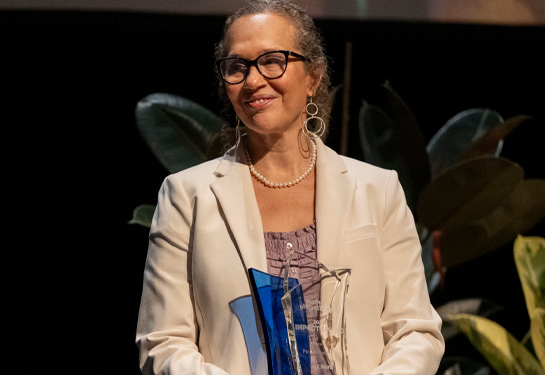
By appearing in one of the nation's leading physician journals, the Viewpoint article brings the conversation to doctors, health system leaders and policymakers whose decisions help shape how quality of care is measured and evaluated. In addition to her leadership role, Kennedy is also an associate professor at the Betty Irene Moore School of Nursing at UC Davis.
Every member of the healthcare team contributes to patient outcomes. Measurement drives attention. Our goal is to better understand and measure the unique contributions nursing brings to that work.—Lori S. Kennedy, director of the Center for Nursing Science
“Nurses provide the majority of direct patient care in hospitals, and decades of research link the quality of nursing care to length of stay, mortality and readmissions. Yet the measures that drive payment, accreditation and public accountability capture only a narrow slice of what nurses do,” Kennedy said.
For example, nurses often spot an early warning sign in a patient’s condition, or help a family understand their treatment options, or advocate for a patient, or bring together members of a care team — and that work can make a real difference. Yet, Kennedy noted, many of those contributions have been difficult to measure.
Kennedy as lead author and two co-authors report that their framework could help researchers and health systems better recognize aspects of nursing care that traditional quality measures often overlook.
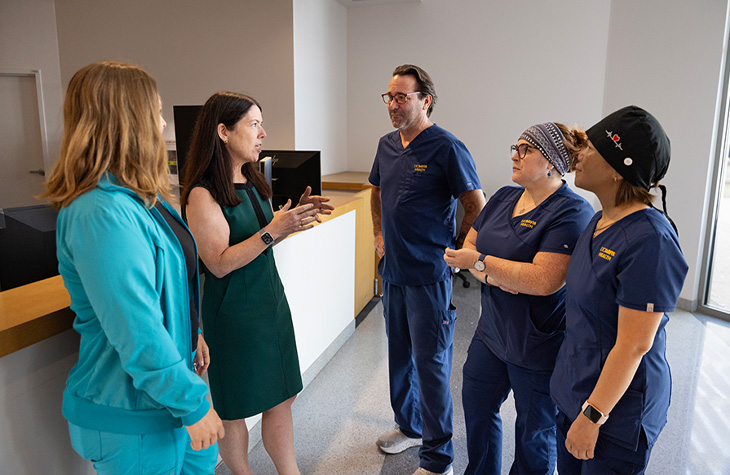
Lori Kennedy, second from left, says current quality measures focus on patient harm outcomes but should consider the full range of nursing impact.
Defining the full scope of nursing practice
The article states how nursing quality measures mainly focus on harm metrics, such as infections, falls and pressure injuries. These outcomes matter, but they measure nursing by the harm that occurs when high-quality nursing care is missing. Core aspects of care that nurses have long prioritized, such as symptom management, end-of-life care and clinical surveillance, have no dedicated measures.
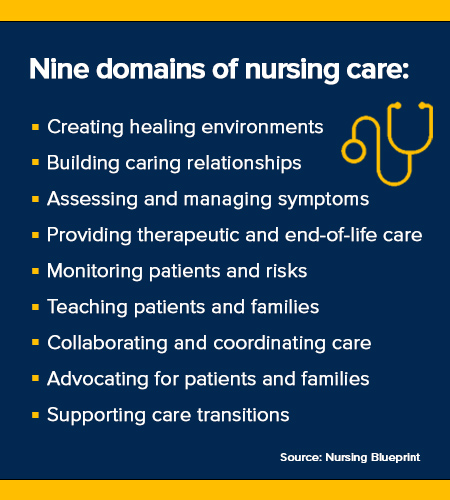
The domains identified in the framework span the full range of nursing practice across patient populations and care settings. For each domain, the authors identify candidate outcome measures. Some build on existing tools, others would need to be developed and tested before adoption.
Helping researchers better understand nursing care
The nine domains of nursing care reflect the essential roles nurses play in delivering compassionate, coordinated and patient-centered care across settings.
Researchers have long known that nursing care plays a key role in patient safety and recovery. Kennedy said the work aligns with efforts at UC Davis Health to better understand and highlight nurses' contributions in this area. She and her fellow authors, Laura Beth Kalvas of Nationwide Children's Hospital and Martha A.Q. Curley of the University of Pennsylvania School of Nursing, encourage collaboration among nurses, physicians, healthcare leaders, credentialing bodies and policymakers to advance approaches that recognize the full value of nursing care.
“This is not about elevating one profession over another,” Kennedy said. “Every member of the healthcare team contributes to patient outcomes. Measurement drives attention. Our goal is to better understand and measure the unique contributions nursing brings to that work.”
For patients and families, Kennedy says the message is simple: Nurses play a vital role in care and recovery. Better understanding that impact can help improve care for everyone.