New endowed professorship will expand impact of light-based technologies in health care
By Clémentine Sicard
Anonymous donation will help NCIBT Director Laura Marcu advance cancer and heart disease treatments
(SACRAMENTO)
Laura Marcu, professor in the Departments ofNeurological SurgeryandBiomedical Engineering, has been appointed to the Endowed Professorship of Neurosurgical Research. This distinguished appointment is made possible by an anonymous donation. It provides funds for scientific discovery and development that have the potential to improve the lives of patients with neurological injury or disease.
“I am deeply grateful for this endowment. It will enable transformative research, accelerate clinical translation and expand the impact of emerging light-based or biophonic technologies in patient care,” Marcu said.
At NCIBT, Marcu is building on her pioneering work in medical applications of light-based technologies, particularly Fluorescence Lifetime Imaging (FLIm). FLIm is a pen-like device that surgeons can use to scan and highlight unhealthy tissue in real time to treat cancer and heart disease.
First developed in an engineering lab by Marcu and her team, FLIm is one of the most advanced clinical fluorescence lifetime imaging systems in the world. It’s currently being used at UC Davis Health — with great accuracy and success — to collect data and prove its value for widespread use.
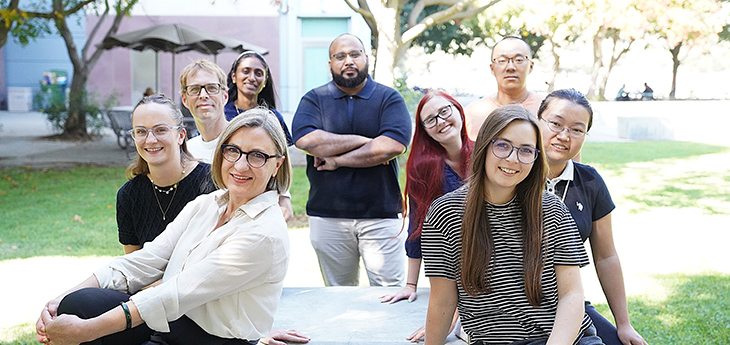
Endowed Professor of Neurosurgical Research Laura Marcu with members of her lab.
Expanding NCIBT’s impact
The endowment was made possible through a generous $1.5 million anonymous gift.
“Philanthropy is very important because it provides the flexibility needed to accelerate the translation of technologies such as FLIm from discovery at the bench top to clinical applications, and ultimately to the broader population,” Marcu explained. “Through this endowment, I am hoping to better emphasize the role that the NCIBT can play, not just institutionally, but nationwide, and expand its visibility and impact.”
The NCIBT — the first center of its kind at UC Davis — is critical to the dissemination and future commercialization of a range of optical spectroscopy and imaging technologies. It’s also critical for training the next generation of scientists. The endowment ensures that this work will continue to advance innovation and education for years to come.
Endowed chairs and professorships are among the university’s highest faculty honors and are created through donor support. Their invested funds generate enduring resources that empower professors to advance research, mentor students and drive innovation that benefits society.
Targeted approach for cancer and heart disease
Marcu’s lab is advancing the use of FLIm across several medical specialties, with the goal of giving clinicians clearer, real-time insight into tissue health. Their work currently focuses on surgical oncology, cardiovascular diagnostics and regenerative medicine.
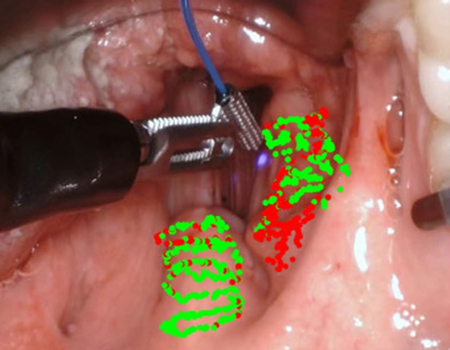
FLIm technology integrated into transoral robotic surgical system to detect cancerous tissues.
While operating on a tumor, FLIm allows surgeons to detect abnormalities in tissue. Because tumor cells have different optical properties than healthy tissue, their fluorescence changes under the device’s light — helping surgeons more accurately identify cancerous areas. FLIm has already been tested and validated inbrain cancerand inhead and neck cancersurgeries.
For the prevention and care of cardiovascular disease and stroke, FLIm can identify signs of damage to blood vessels, such as plaque buildup in coronary arteries.
“We are developing intravascular catheter systems that better characterize the plaques that are more likely to rupture and lead to critical events such as the heart attacks,” Marcu said.
This can assist with better therapies, understanding the history of these plaques and what treatment may be more appropriate for a particular patient.
“Cardiovascular disease and cancer are the leading causes of death in the United States,” Marcu said. “These are just a few examples of how this technology can be used to address major societal health problems.”
Bridging the gap from bench to bedside
Working at the intersection of engineering and medicine has always been at the core of Marcu’s work.
“There can be a language barrier between engineers and clinicians who have different ways of thinking and doing things,” said Marcu. “Working in a clinical environment taught me how to communicate with physicians and surgeons, and that helped me bridge between scientific and medical communities.”
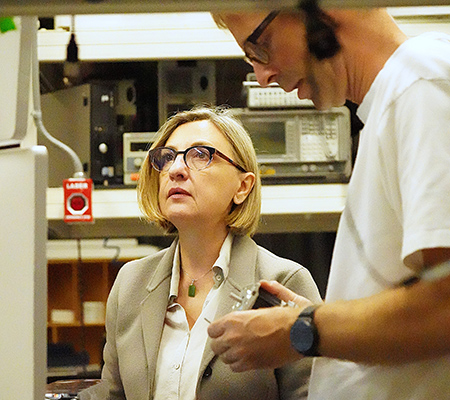
Professor Laura Marcu with Julien Bec, engineering director at the Marcu Laboratory.
Marcu’s research in FLIm and other imaging systems demonstrates this interdisciplinary expertise and the importance of developing tools that translate from the research lab to patient care.
“I have always enjoyed connecting ideas across disciplines and interacting with people who have come from different domains and perspectives,” Marcu said. “This is what stimulates creativity and technological innovation with impact on patient care.”