Annual Reports
-

2025-2026 Year in Review
Read our 2025-2026 Year in ReviewThis year, the UC Davis Alzheimer’s Disease Research Center (ADRC) celebreates 35 years as a nationally recognized NIH-funded Alzheimer’s Disease Research Center advancing discoveries that improve the understanding, prevention, diagnosis and treatment of Alzheimer’s disease and related dementias.
With our National Institutes of Health P30 core infrastructure grant freshly renewed, we look forward to the discoveries that await us in the next five years and beyond. The renewal also brings a season of transition in the center’s leadership: Co-director Charles DeCarli, M.D., will complete the wind-down of his longtime director role in the center. In parallel, Co-director Rachel Whitmer, Ph.D., is moving as planned into the role of sole center director. The transition will be completed in June 2027.
Dementia remains among the most pressing public health challenges of our time. More than 7 million Americans age 65 and older are living with Alzheimer’s disease, and the number of new dementia cases is projected to grow dramatically in the decades to come.
Our center continues to meet this moment through major research investments, including new and renewed studies examining brain health in Hispanic/Latino and Vietnamese American communities. We continue investment in emerging approaches that leverage omics technologies, artificial intelligence, and advanced neuroimaging. The opening of Aggie Square and the growth of our research community, including the addition of new faculty expertise, create exciting opportunities
for collaboration and discovery.One of the fastest-developing frontiers in brain health today is dementia prevention, and as a site of the groundbreaking US-POINTER trial, our faculty, staff and research participants continue to reveal the specific lifestyle changes individuals can make today to enhance brain health now and reduce future risk. The center continues to add community programs and resources to support our collective health.
We are especially proud of the people who make this work possible: Our participants and families, community partners, trainees, faculty, staff, and supporters. Together, we ensure our research reflects the diversity of the communities we live in and serve — and that scientific advances translate into our shared vision of neurological health for all.
Thank you for partnering to build on 35 years of progress in our mission to treat, prevent, and ultimately cure Alzheimer’s disease and related dementias.
Archived Reports
If you are unable to access this content due to a disability, please email neurocommunications@health.ucdavis.edu for assistance.
-
2024-2025 Year in Review
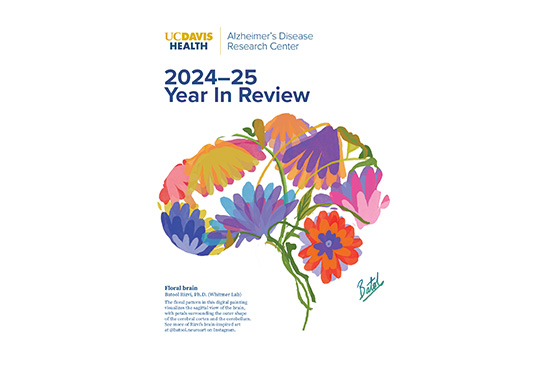
Read our 2024-2025 Year in ReviewAn estimated 6.5 million older Americans lived with Alzheimer’s disease in 2022, By 2060, this figure is projected to grow to 13.8 million people.1 That means 42% of Americans over age 55 will eventually develop dementia.
As one of 34 NIH-funded ADRCs in the nation, we are home to paradigm-shifting thought leaders leading novel research in prevention, causes, and treatments for Alzheimer’s disease and related dementias. Our center follows X people annually over X studies. Our research impacts the real, daily lives of all of us as we care for a person with memory challenges or receive that care ourselves.
Select findings across our more than 100 published papers this past academic year include:
- Larger brains are developing among people from younger generations;
- A novel MRI biomarker predicts dementia;
- In the oldest-old among us, depression can impact brain volume.
We completed impactful studies such as the first multi-domain lifestyle intervention trial on cognitive decline in the. U.S, and the first cohort study following elderly Vietnamese Americans to identify how adversity and vascular risk factors impacts brain health.
In addition, we developed new technologies, including a new automated way to screen human brain tissue samples for strokes. This powerful research grows out of the center’s location within the world-class interdisciplinary community of more than 300 neuroscientists who call UC Davis home. And we’re always looking for new partners.
Our hope in providing this report is to make visible the collaboration and training opportunities, research resources and unique strengths the UC Davis ADRC offers. We seek to inspire you, as a research colleague, scientific partner, philanthropist or member of our community, to connect with our ADRC. And we’d love for you to share our work with your professional and personal communities.
We also recognize our debt of gratitude to the many donors, supporters and — especially — research participants who make our work possible. Your commitment to neurological health for all is changing the landscape of brain health.
Join our quest to treat, cure and one day prevent Alzheimer’s disease and other dementias.