
Moving forward in the field
Research
Our research team leads national breakthroughs in pediatric care and violence prevention to define the future of emergency medicine.

Research
Serving the UC Davis community since 1973, the Department of Emergency Medicine has evolved from clinical care and education into a major research hub. Recent major grants include $2.4M for pediatric care (PECARN), $3.7M for violence prevention, and $745K for brain injury studies in older adults, with $16M in additional grants pending.
Driven by active faculty engagement, our expanding publications reflect a growing commitment to diverse research topics.
-

The PediDOSE Research Study
Seizures in children are life-threatening emergencies. Currently, paramedics treat pediatric seizures using midazolam, but dose calculation delays result in about half of pediatric patients receiving improper doses and one-third arriving at the emergency department still seizing.
Led by Principal Investigator Dr. Manish Shah, the national PediDOSE trial evaluates whether a simple, age-based dosing protocol helps paramedics treat seizures faster and more accurately. Locally, the Sacramento Fire Department and Sacramento Metro Fire Department are partnering with UC Davis ED to test this protocol for patients ages 6 months to 13 years. Because immediate care is critical, the study uses an ethics-approved Exception from Informed Consent (EFIC) process, and parents will be notified following enrollment.
Contact: Site Principal Investigator—Daniel Nishijima, M.D., M.A.S.
-

The PROMPT BOLUS Research Study
Learn more about PROMPT BOLUS StudySepsis is a severe, life-threatening infection affecting approximately 75,000 U.S. children annually. Immediate treatment with IV fluids and antibiotics is critical to prevent organ damage, but researchers need to determine which standard IV fluid yields the best patient outcomes.
- The Goal: Compare two standard, safe IV fluid options—Normal Saline (NS) and Balanced Fluids (BF)—to identify which is more effective and reduces hospital stays.
- Emergency Consent (EFIC): Because sepsis requires rapid treatment, eligible patients are enrolled using Exception from Informed Consent (EFIC). Parents or guardians are notified as soon as possible after enrollment.
- Community Choice: Community members can review study details, contact the research team, or opt out of participation at any time.
Contact: Site Principal Investigator—Cheryl Vance, M.D.
-

Violence Prevention Research Program
Learn more violence prevention researchThe UC Davis Violence Prevention Research Program (VPRP) is a multi-disciplinary program of research and policy development focused on the causes, consequences, and prevention of violence.
-
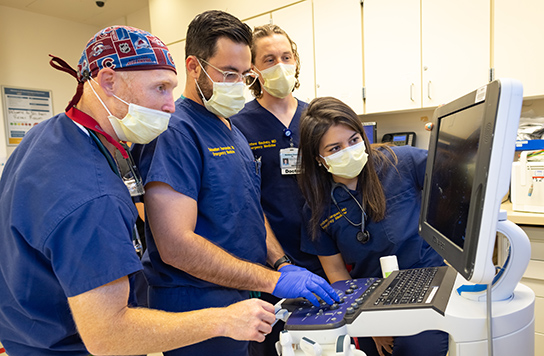
Education Programs
The UC Davis Department of Emergency Medicine offers a two-year Emergency Medicine Research Fellowship, combining clinical research with a master’s degree in Clinical Epidemiology or Public Health. Research opportunities (including Emergency Medicine Research Assistant Program for undergraduates) are available for undergraduate students, medical students, and residents. To get involved, contact Vice Chair of Research Daniel Nishijima, M.D., M.A.S.
Current research projects:
- Computational modeling of emergency services
- Video-assisted laryngoscopy in emergencies
- Ventilator asynchrony in critically ill or injured patients
- Early treatments for patients with septic shock
- TXA for non-traumatic hemorrhage
- Coagulation studies for new oral anticoagulants
- Methods to improved ED flow
- Airway management in patients with traumatic brain injury
- Sedation monitoring in patients with traumatic brain injury
- Biomarkers for traumatic brain injury
- Prehospital guidelines for anticoagulated trauma patients
- Utility of the FAST examination in children with blunt torso trauma
- Implementation of a neuroimaging decision rule for childhood head trauma
- TXA for Pediatric trauma
- Cerebral edema in pediatric diabetic ketoacidosis
- Improving the care of acutely ill and injured children in rural emergency departments with telemedicine
- Biosignatures in young febrile infants
- Medications for seizures
- Emergency department frequent users: community solutions
- Use of firearms in youth suicides
- Case control study of firearms retailers in California
- Gun Violence in California
- Impact of ambulance diversion on resident education study
- Can patient centered outcome measures be used to predict length of stay?
- Early detection of pathogens at triage
- Antibiotic stewardship in the ED
- Identification of rhinovirus via novel methods
- Ultrasound for peritonsillar abscess
- Cardiac resuscitation at STEMI versus non-STEMI centers
- Gender differences in acute coronary syndrome
- PET scan for cardiac risk stratification