
Giving
A chance encounter leads to sight-saving care
By Kimberly Cummings and Neda Dastgheyb, M.D.
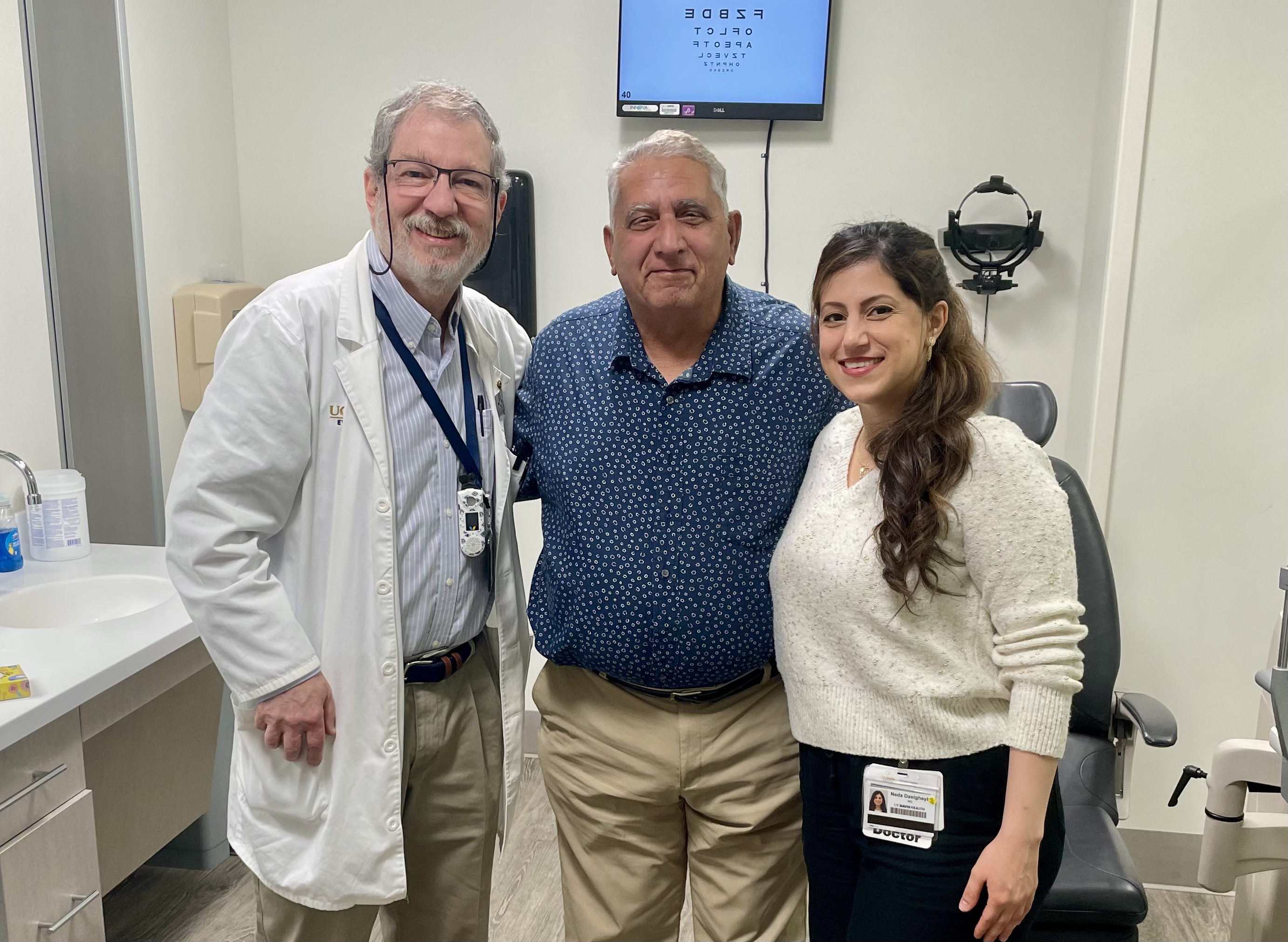
Neda Dastgheyb, M.D., a senior ophthalmology resident, is emblematic of our residency program. She encountered a suffering patient and ensured that he received definitive management for phacomorphic glaucoma, a condition that can cause irreversible vision loss. The patient now has 20/20 vision and is able to continue working as a rideshare driver. This story highlights how our residents consistently go above and beyond their expected duties to care for patients who present with urgent problems.
Unable to find an open entrance to the Ernest E. Tschannen Eye Institute the morning after Thanksgiving 2024, Maryam Paras noticed a woman waiting alone in a parked car in the patient drop-off area.
Desperate to find help for her 64-year-old father, Abdul Rauf, she hurried to the car.
"My father needs immediate help," she pleaded.
For weeks, Rauf had endured worsening eye pain and vision decline. As his vision rapidly deteriorated, he feared he would lose not only his eyesight but also his livelihood as a rideshare driver.
The Eye Institute was closed for the holiday, but after finding conflicting information online about its hours, Paras and her father had decided to drive to UC Davis anyway, hoping someone could help.
The woman rolled down her window and listened. "Don’t worry,” she said. “My daughter is an eye doctor. She’ll help you.” Within minutes, a chance encounter would set in motion a chain of events that saved Rauf's sight.
An ophthalmology resident steps in
That morning, Neda Dastgheyb, M.D., then a second-year ophthalmology resident, was on call in the Emergency Department.
Dastgheyb's mother was visiting for the Thanksgiving holiday and had accompanied her to campus to help transport equipment from the Eye Institute to the hospital. While Dastgheyb briefly stepped inside the Eye Institute to retrieve a portable slit lamp and other supplies, her mother remained in the car.
"If the portable slit lamp in the hospital hadn't malfunctioned, I never would have been at the Eye Institute that morning," Dastgheyb recalled.
When Dastgheyb returned, she found Rauf with one hand covering his eye, clearly in severe pain. Concerned he could have dangerously elevated eye pressure, she directed the family to the Emergency Department and assured them she would meet them there to expedite his care.
Every hour Dr. Neda came to check on my father,” Paras recalled. “She never made us feel alone. We were terrified, but she reassured us every step of the way.”—Abdul Rauf
A race against time
When “Dr. Neda” as some patients call Dastgheyb, evaluated Rauf in the Emergency Department, she found his eye pressure measured 60 mmHg—three times the normal range of 10-21 mmHg. She diagnosed him with phacomorphic glaucoma, an ophthalmic emergency caused by an advanced cataract that blocks the eye's drainage system.
"Without prompt treatment, the elevated pressure can permanently damage the optic nerve and lead to irreversible vision loss," Dastgheyb said.
A team effort to save sight
Rauf was treated immediately with pressure-lowering eye drops and intravenous medication to reduce his eye pressure.
"Every hour Dr. Neda came to check on my father," Paras recalled. "She never made us feel alone. We were terrified, but she reassured us every step of the way."
Within a few days, Rauf underwent sight-saving cataract surgery to remove the swollen lens causing the dangerous increase in eye pressure. The surgery was performed by James Brandt, M.D., director of Glaucoma Service, and Tessnim Ahmad, M.D., at the UC Davis Eye Center.
"Timing is everything with phacomorphic glaucoma," Brandt said. "Lowering the pressure quickly and removing the cataract as soon as it is safe can mean the difference between preserving vision and permanent blindness."
Timing is everything with phacomorphic glaucoma. Lowering the pressure quickly and removing the cataract as soon as it is safe can mean the difference between preserving vision and permanent blindness.”—James Brandt, M.D.
Care beyond diagnosis
A medical interpreter who speaks four languages, Paras works with physicians and patients on a regular basis.
“Medical language is different from normal language,” said Paras. “Dr. Brandt, Dr. Ahmad and Dr. Neda spoke to my father with so much respect, patience and kindness. They understand there’s a language barrier. They know my father does not understand medical terminology and made sure everything was easy to understand.”
Full-circle moment
Several months later, Dastgheyb called an Uber to take her to the Eye Institute.
"As soon as I got into the car, the driver turned around, smiled and said, 'Dr. Neda?!'" Dastgheyb recalled. "I couldn't believe it—it was Mr. Rauf."
Throughout the ride, Rauf spoke about how grateful he was for the care he had received. He repeatedly thanked Dastgheyb and asked her to thank her mother as well.
"It made me realize how unlikely that morning really was," Dastgheyb said. "My mother happened to be visiting for Thanksgiving, and I never would have gone to the Eye Institute that day if the portable slit lamp in the hospital hadn't malfunctioned. Sometimes the smallest, most unexpected moments can change someone's life."
The ride ended where the story had first begun—outside the Ernest E. Tschannen Eye Institute, where they had met months earlier. Today, Rauf has 20/20 vision and is back behind the wheel, driving passengers throughout Sacramento.
"We thought every door was closed that day," Rauf said. "But one door opened, and it changed my life."
UC Davis Eye Center Residency Program Mr. Rauf’s story reflects the core values of the UC Davis Eye Center residency program: delivering exceptional clinical care with compassion, responding confidently to urgent and complex cases and going beyond what is expected to meet patients' needs. By combining advanced medical training with a deep commitment to service, residents are prepared to provide outstanding care while advancing UC Davis Health's mission to improve lives through compassionate, innovative and patient-centered care.

