

Showmenu

Research and Technology | Radiation Oncology | UC Davis Health

Exploring advanced radiotherapy

Research and Technology

We’re committed to research on innovative treatment approaches to manage many cancer types.

Modern radiation therapy suite featuring a linear accelerator and treatment couch.

Research

The nationally recognized faculty in the UC Davis Department of Radiation Oncology conduct research focused on innovative approaches to cancer treatment.

Departmental research spans clinical trials and translational studies, with emphasis on advanced radiation techniques, radiation biology, image‑guided therapy, quality of life outcomes, and chemoprevention. Robust clinical databases support high‑quality retrospective research, and faculty scholarship is widely published and cited within the field of radiation oncology.
Advanced Treatment Technologies

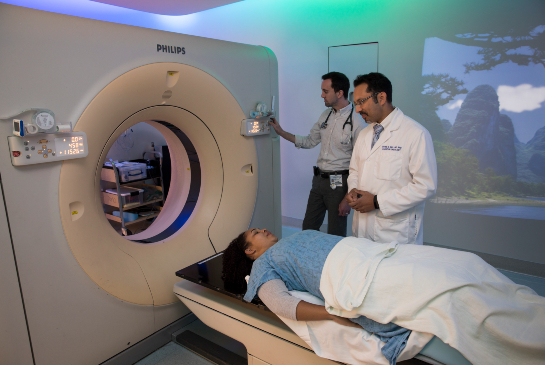
  • CT simulator with ambient patient experience design, displaying underwater visuals to create a calming environment

    CT Simulation (CT SIM) with Ambient Experience

    CT simulation occurs during the treatment planning stage following a consultation. UC Davis uses a state-of-the-art CT scanner capable of producing real-time, digitally constructed radiographs (DRRs). This advanced machine allows the clinician to perform a virtual simulation on a CT dataset based on each patient’s unique anatomy. 

    Patients coming to UC Davis are fortunate to be able to experience a new, high-tech CT suite called the Ambient Experience that combines advanced treatment with an environment that is more positive for the patient. With Ambient Experience, patient comfort is at the forefront.

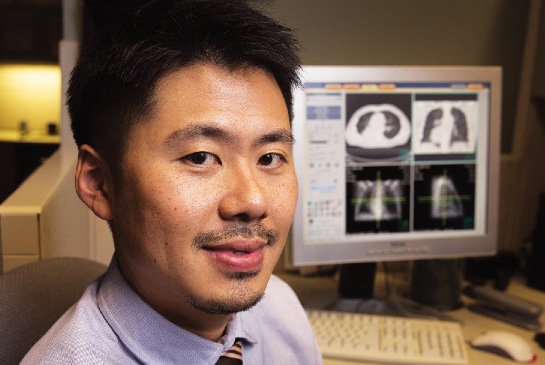
  • Radiation therapist reviews treatment planning data on a computer workstation

    Image Guided Radiotherapy (IGRT)

    Image Guided Radiation Therapy (IGRT) uses imaging during treatment to precisely locate the tumor and guide radiation delivery. By combining imaging and treatment, clinicians can see the treatment area in real time and adjust patient positioning as needed.

    Frequent imaging before each session allows for more accurate targeting of the tumor while minimizing exposure to surrounding healthy tissue. This precision can enable higher, more effective radiation doses with fewer side effects.

    IGRT may also support real-time adjustments during treatment when changes in tumor position or anatomy occur. While highly effective, IGRT is not appropriate for every patient or condition.

  • VisionRT

    Vision RT is an advanced surface‑tracking technology that improves accuracy and patient comfort during radiation therapy.

    Using ceiling‑mounted cameras, it creates a real‑time 3D model of the patient’s body surface to guide precise positioning before and during treatment. The system continuously monitors movement with sub‑millimeter accuracy, ensuring patients remain in the correct position.

    If movement occurs, the system alerts clinicians and can pause treatment to maintain safety and precision. It can be used across multiple treatment areas, from head to toe.

  • Richard Valicenti stands in front of an Elekta Versa HD linear accelerator used for patient treatments

    Intensity Modulated Radiation Therapy (IMRT)

    Intensity Modulated Radiation Therapy (IMRT) is an advanced form of radiation therapy that delivers precise, high doses to tumors while limiting exposure to nearby healthy tissue. This accuracy can improve treatment outcomes and may reduce side effects.

    IMRT uses a linear accelerator equipped with multileaf collimators that shape and modulate the radiation beam. The machine rotates around the patient, delivering radiation from multiple angles to match the tumor’s shape as closely as possible.

    The beam is composed of many small “beamlets,” allowing clinicians to adjust intensity and avoid surrounding normal tissues. This highly targeted approach enables effective treatment with greater precision than conventional radiation therapy.

  • Prostate Brachytherapy

    Prostate brachytherapy (seed implant therapy) is an advanced treatment in which tiny radioactive seeds are placed directly into or near the prostate tumor. This allows high doses of radiation to target cancer cells while minimizing exposure to surrounding tissues such as the bladder and rectum.

    Up to 125 small seeds—about the size of a sesame seed—are implanted using ultrasound and X‑ray guidance. The seeds deliver radiation over several months and remain safely in place permanently, even after the radiation has diminished.

    This minimally invasive procedure is typically performed on an outpatient basis with local or regional anesthesia and requires little recovery time. Patients can usually resume normal activities quickly, though brief precautions around children and pregnant individuals are recommended.

  • Radixact Radiotherapy

    Radixact® radiotherapy is an advanced treatment system that delivers highly precise, image‑guided radiation using a helical (spiral) approach. This technology allows radiation to be delivered continuously as the machine rotates around the patient, improving dose accuracy and coverage of complex tumor shapes.

    Radixact combines integrated imaging and treatment delivery, enabling clinicians to adjust for patient movement and anatomical changes at each session. This helps ensure consistent targeting of the tumor while minimizing exposure to surrounding healthy tissue.

    Designed for a wide range of cancers — including large or irregularly shaped tumors — Radixact offers efficient, highly personalized treatment with advanced precision and safety.

  • High Dose Rate (HDR) Brachytherapy

    High‑Dose Rate (HDR) brachytherapy treatment delivers radiation directly within or next to the tumor, rather than from an external source. 

    A radioactive source is temporarily placed near the tumor, allowing high, targeted doses of radiation while limiting exposure to surrounding healthy tissue. Because the radiation source is removed after treatment, patients are not radioactive afterward.

    This approach can significantly shorten treatment time; from several weeks of daily external radiation to as few as 3 to 10 days, depending on the diagnosis. It may also allow patients to begin chemotherapy sooner and can result in fewer side effects. HDR brachytherapy is highly effective for certain cancers, including cervical cancer as an alternative to surgery, and is often used after surgery to help prevent recurrence.

  • Stereotactic Body Radiation Therapy (SBRT)

    Stereotactic Body Radiation Therapy (SBRT) is a highly precise treatment that delivers high doses of radiation to tumors outside the brain, such as those in the lungs, liver, and spine. UC Davis has been a regional leader in SBRT for more than 10 years.

    Using advanced imaging and patient immobilization, SBRT targets tumors with exceptional accuracy — even in areas affected by normal body movement. This allows radiation to be delivered in a few high‑dose treatments rather than many lower‑dose sessions.

    SBRT is often used for patients who are not candidates for surgery and offers a safe, effective alternative with focused treatment and reduced exposure to surrounding healthy tissue. Treatments are delivered using advanced linear accelerators designed for precise, image‑guided therapy.

  • Gamma Knife Radiosurgery

    Gamma Knife radiosurgery is a highly precise, non‑invasive treatment used to target tumors and other lesions in the brain and select head and neck areas. UC Davis is the only provider of the Perfexion® Gamma Knife system in the Sacramento region.

    This advanced technology delivers focused radiation directly to the tumor while preserving surrounding healthy tissue. Despite the name, no surgical incisions are made, and treatment is typically completed in a single session. Gamma Knife can treat multiple lesions at once and is especially beneficial for patients who are not candidates for surgery or have previously received brain radiation. It offers a safe, effective option with minimal disruption to daily life.