
Hazardous Material Inventory Tips
The Hazard Communication (hazcom) standard requires employers to maintain a current inventory of hazardous materials used in work areas. Inventory responsibilities fall to individual departments.
The most frequently asked question is how one knows how to determine if an item is a hazardous material that belongs on the list.
What doesn’t belong on the hazmat inventory?
Articles: an article is a manufactured item other than a fluid or particle: (i) which is formed to a specific shape or design during manufacture; (ii) which has end use function(s) dependent in whole or in part upon its shape or design during end use; and (iii) which under normal conditions of use does not release more than very small quantities, e.g., minute or trace amounts of a hazardous chemical (as determined under paragraph (d) of this section), and does not pose a physical hazard or health risk to employees. (Fed OSHA definition)
For example, our computers and monitors have hazardous materials within, but there is no risk of exposure. These items are articles, and SDSs are not needed.
What belongs on the hazmat inventory?
Always evaluate chemicals in all physical forms, e.g., liquids, solids, gases, fumes, vapors, and mists. Also consider chemicals generated during work operations, such as welding fumes and exhaust fumes.
This may bring up a question: how does one know if a chemical has one or more of the following characteristics? Relevant information is supposed to be on the container. If that doesn’t help, see if there’s a SDS for the material. Often, manufacturers will provide SDSs that simply say that the material in question is not hazardous, so the material does not have to be on the inventory. If all else fails, contact the UC Davis Health Hazardous Materials Program Administrator, srheller@health.ucdavis.edu or 916-734-0295.
Characteristics of hazardous chemicals
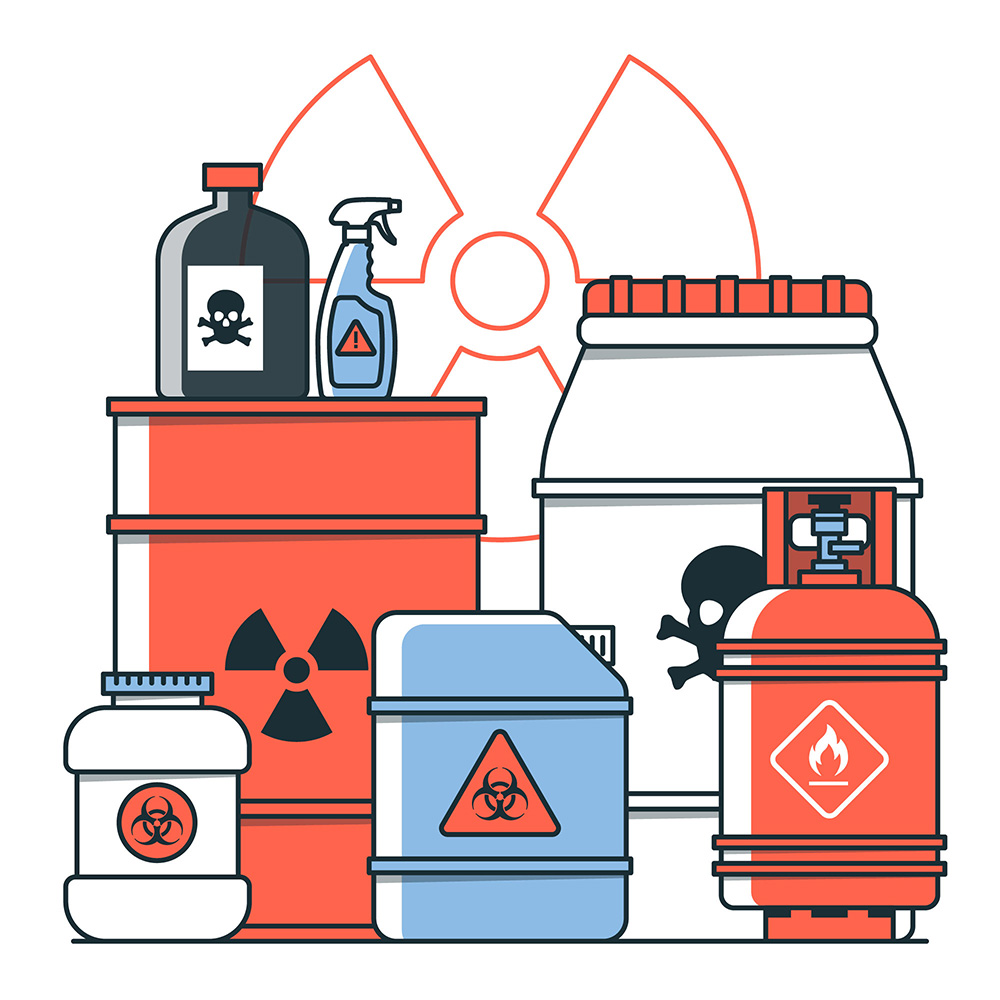
Physical hazard is any chemical that is:
- A combustible liquid
- A compressed gas
- Explosive
- Flammable
- An organic peroxide
- Pyrophoric (catches fire upon exposure to air)
- Unstable (reactive)
- Water-reactive
A health hazard is any chemical that may produce acute or chronic health effects in exposed employees, for example:
- Carcinogens
- Toxic or highly toxic agents
- Reproductive toxins
- Irritants
- Corrosives
- Sensitizers
- Hepatotoxins (liver)
- Nephrotoxins (kidney)
- Neurotoxins (brain)
- Agents that act on the hematopoietic (blood-forming) system
- Agents that damage the lungs, skin, eyes, or mucous membranes.