
Annual Reports
Archived Reports
Enjoy these annual highlights of our achievements in clinical care, research, education, and community.
-
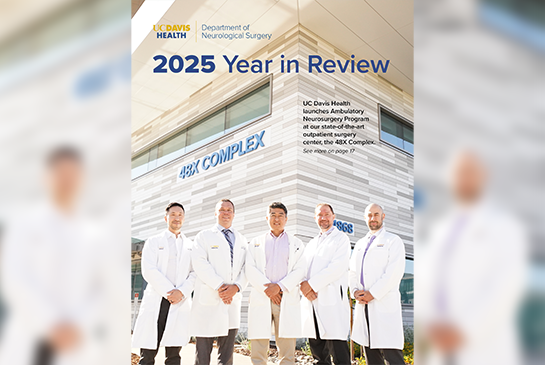
2025 Year in Review
Read our 2025 Year in ReviewWe're celebrating a year of innovation and growth as we expand access to tomorrow's neurosurgery today. We launched our Ambulatory Neurosurgery Program with the opening of the 48X Complex, a state-of-the-art outpatient center where we integrated new technologies to offer minimally invasive care now while anticipating needs to come. Our research enterprise continued to define the future of neuroscience and neurosurgical care. The UC Davis Neuroprosthetics Lab published on the first brain-computer interface enabling a person with ALS to "speak" in real time — underscoring the transformative potential of neuroscience and engineering working together. We welcomed three new researchers and relocated several labs to Aggie Square, the center of a growing hub for interdisciplinary collaboration. Our residency program trained future neurosurgeons in emerging technologies like medical extended reality (MXR) while encouraging robust research activities. Community collaborations flourished: Our Global Neurosurgery Program advanced care in Bolivia and Ethiopia while expanding resident opportunities to grow as global leaders. At home, our neurocritical care advanced practice providers (APPs) partnered with Travis Air Force Base on high-acuity training for military clinicians. Read on and discover the energy, innovation and impact driving our work forward.
-

2024 Year in Review
Read our 2024 Year in ReviewOur high-impact research received national and international recognition, particularly our Neuroprosthetics Lab's paper announcing a new brain-computer interface (BCI) to translate brain signals into speech for people with paralysis — with up to 97% accuracy. We've expanded our research enterprise in exciting new directions by welcoming four new research faculty, including our first joint appointee with the UC Davis Center for Neuroscience and a second with the Department of Biomedical Engineering. This year, the department became the home of the UC Davis National Center for Interventional Biophotonic Technologies. On the clinical side, we expanded our faculty, extended our partnership with Shriners Children's Northern California, and introduced new treatment paradigms including endoscopic spine surgery and the use of medical extended reality (augmented reality) in the operating room and for patient, resident and medical student education. Our education and training program continues to grow, with mentorship and outreach efforts targeting high school, undergraduate, and graduate and medical school students. We are excited about our Global Neurosurgery Program, which has produced collaborations in surgery and on meaningful improvement projects to enhance the lives of individuals and the health systems that care for them in Bolivia and Ethiopia, as we continuously expand access to tomorrow's neurosurgery today.