UC Davis expands clinical trials to rural communities
By Marybeth Bizjak
As a UC Davis Cancer Care Network affiliate, Enloe Health Regional Cancer Center brings the benefits of an academic medical center to rural areas
(SACRAMENTO)
After Chico resident Debbie Pease was diagnosed with breast cancer, she learned that she qualified for a clinical trial throughUC Davis Comprehensive Cancer Center. It was designed to test the effectiveness of low-dosetamoxifenin treating women with early-stage breast cancer.
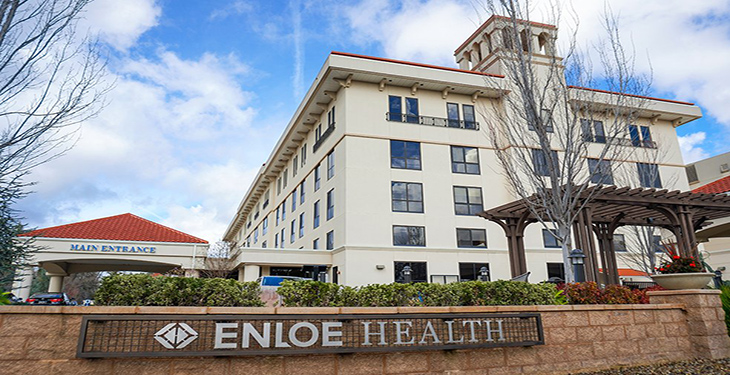
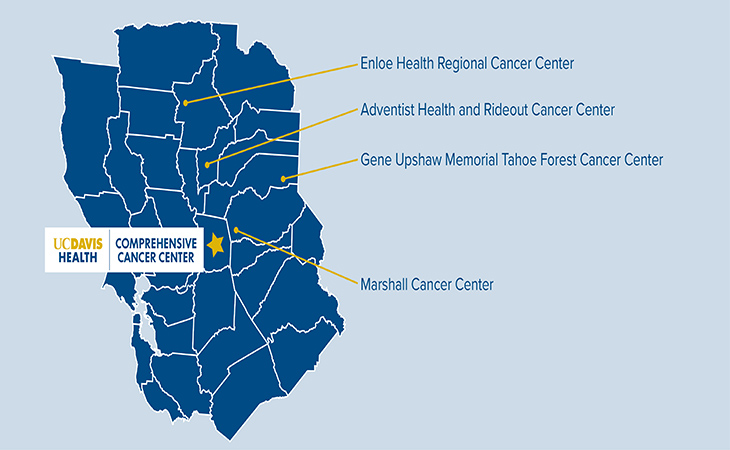
That’s because Enloe is aUC Davis Cancer Care Network(CCN) affiliate — one of four sites in Northern California where patients benefit from the services of a major academic medical center. Not having to drive to Sacramento for the study was important to Pease. When her husband, John, underwent a heart procedure a few years ago, they had to go to Marysville, 50 miles away. “It was a miserably long day,” she recalled. “Enloe’s a mile from my house. I’m so grateful my travel time is zip.”
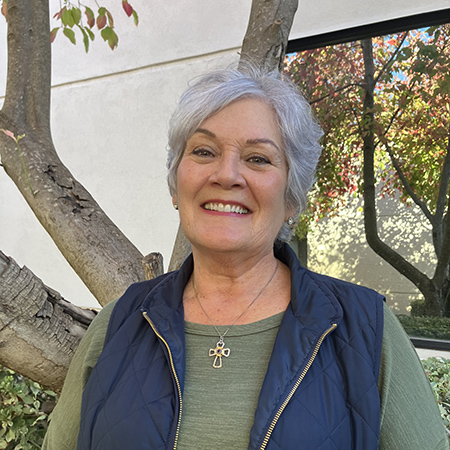
Breast cancer survivor Debbie Pease enrolled in a UC Davis Comprehensive Cancer Clinical trial at her local Enloe Health in Chico (courtesy Marybeth Bizjak).
A key benefit of being an affiliate is access to clinical trials.
Pease’s oncologist,Nicole Whitlatch, is lead investigator for the LoTam trial at the Enloe site. The study aims to determine if a low dose of tamoxifen can effectively prevent disease recurrence as usual hormonal therapy, includingaromatase inhibitors, in patients with stage 1 breast cancer. If successful, low-risk patients like Pease may be able to avoid the unpleasant side effects — hot flashes, mood swings, night sweats and joint pain — that often accompany traditional hormonal therapy.
From routine screening to stage 1 diagnosis
Pease, 68, had been getting yearly mammograms and occasional biopsies since 2017 when she was diagnosed withatypical lobular hyperplasia. So, she was not overly concerned this past summer when, after her annual scan, she was called back for additional imaging and a biopsy.
Until now, she received the results — always negative — by mail. This time was different. Her doctor’s office phoned and asked her to come in on a Friday afternoon. “I knew this wasn’t a social call,” she said, half joking.
She was diagnosed with stage 1invasive ductal carcinomaand, on July 23, underwent alumpectomy, then five radiation treatments at Enloe over the course of a week. Whitlatch, her oncologist, mentioned the clinical trial.
“She’s generally quite healthy, had very early-stage breast cancer and fit all the criteria,” Whitlatch said.
Making the decision
Pease consulted with a friend who was treated for breast cancer 15 years prior. Her friend found the treatment side effects intolerable and encouraged her to join the study. Pease thought about the women who had gone before her, participating in research that resulted in the lumpectomy that she now benefited from. “Let’s do it,” she said.
Whitlatch explained that she would be randomly placed into one of two study arms, receiving either low-dose tamoxifen (the investigational arm), or the standard or higher dose of tamoxifen versus an aromatase inhibitor (standard of care arm).
Because the study isn’t blind, Pease was placed on the standard of care arm, and she elected to take an aromatase inhibitor, letrozole.
“Great. I get to have hot flashes, mood swings and weight gain again,” she recently groused good-naturedly. “I was hoping to get the lesser arm. But it is not that bad. Not a lot keeps me down.”
UC Davis Cancer Care Network sites in rural Northern California communities.
Clinical research that comes to patients
Married for 40 years and retired from her job as an office manager for a local orthodontist, Pease has two grown sons, two young granddaughters and another on the way. She spends much of her time reading, crocheting, “putzing” around the house and walking at a nearby park or at the mall with her husband. Being in the study, she said, hasn’t cramped her style in the least. “I’ve had no bad experiences,” she said. “It hasn’t stopped me from doing anything I’d normally do.” As a benefit, she will be observed by the study’s researchers for 10 years, which gives her an extra sense of security about her health.
Whitlatch has proven especially adept at signing up participants for the LoTam trial. Enloe is consistently in the top three highest-accruing sites among nearly 650 study locations. The Mayo Clinic and Washington University School of Medicine are the other two. She heads up three other breast cancer clinical trials, and Enloe clinicians are involved in 11 additional cancer-related clinical trials, all through Enloe’s status as a CCN affiliate. According toYulia Thorpe, director of the UC Davis Cancer Care Network, more trials will roll out soon.
“Our research involvement with UC Davis has been incredible,” said Whitlatch, who has been at Enloe since 2010. “It’s the most robust research program I’ve been involved with since coming to Enloe.”
She noted that the health system’s affiliation with the CCN is “a wonderful service” for everyone participating. “All the oncologists here are very happy to be involved with UC Davis clinical trials,” she said. “We have a long-term relationship with Davis, referring patients back and forth. And it’s good for our patients. It would be a great hardship for them to have to travel to UC Davis for these trials.”
UC Davis Comprehensive Cancer Center
UC Davis Comprehensive Cancer Center is the only National Cancer Institute-designated center serving the Central Valley and inland Northern California, a region of more than 6 million people. Its specialists provide compassionate, comprehensive care for more than 100,000 adults and children every year and access to more than 200 active clinical trials at any given time. Its innovative research program engages more than 240 scientists at UC Davis who work collaboratively to advance discovery of new tools to diagnose and treat cancer. Patients have access to leading-edge care, including immunotherapy and other targeted treatments. Its Office of Community Outreach and Engagement addresses disparities in cancer outcomes across diverse populations, and the cancer center provides comprehensive education and workforce development programs for the next generation of clinicians and scientists. For more information, visit cancer.ucdavis.edu.