
Immunology and Flow Cytometry
Contact: 916-731-3839
Hours of Operation: 7 days a week 8 a.m.-4:30 p.m.
Location: Specialty Testing Center; 3740 Business Drive, Sacramento
Flow Cytometry
Flow Cytometry is a specialized ancillary test that supports the diagnosis of leukemia and lymphoma by identifying and characterizing abnormal hematopoietic populations. The laboratory offers an extensive panel of surface and intracellular markers optimized to detect leukemic and lymphoid cells with high sensitivity and specificity.
- Diagnostic Flow Cytometry:
- Utilizes 10-color flow cytometry
- Applicable specimen types include peripheral blood, bone marrow, fluids, and tissue samples
- Samples are processed, stained, and analyzed in-house
- Results are reviewed and interpreted by a hematopathologist
- A diagnostic report is issued and made accessible via the Electronic Medical Record (EMR)
- Turnaround time: Typically, 1–3 days
Note: Measurable Residual Disease (MRD) panels are not performed in this laboratory.
- Additional Flow Cytometry Panels:
- Immunodeficiency Panels
- Used for monitoring patients with HIV and other immune deficiency disorders
- Quantitative Lymphocyte Subsets (TBNK)
- Measures T-cells, B-cells, and NK-cells
- Useful for evaluation of primary immune deficiencies, immune monitoring during immunosuppressive therapy, and immune reconstitution post-transplant
- CD19+ B-cell Enumeration
- Monitors B-cell levels in patients undergoing anti-CD20 therapy
- Immunodeficiency Panels
Immunology
The Immunology Laboratory offers a comprehensive menu of diagnostic tests utilizing various methodologies to support the diagnosis and monitoring of immune-mediated, allergic, and protein-related disorders.
Protein Studies
- Protein Electrophoresis
- Performed using a semi-automated, multi-parameter instrument
- Separates serum proteins into six major fractions based on net charge, size, and shape
- Used to screen serum and urine for protein abnormalities, such as monoclonal gammopathies or protein-losing conditions
- Immunofixation Electrophoresis (IFE)
- Conducted on serum and urine samples
- Detects and characterizes monoclonal proteins (M-proteins)
- Often used to confirm and further characterize abnormalities seen on protein electrophoresis
Allergy Testing
- Measures total and specific Immunoglobulin E (IgE) levels
- Includes testing for specific IgE components for:
- Peanuts
- Tree nuts
- Milk
- Eggs
- Performed on an automated immunoassay platform, providing quantitative antibody concentrations in serum
- Aids in the diagnosis and management of allergic diseases
Tryptase Testing
- Performed using a fully automated immunoassay
- Assists in the evaluation of mast cell-related disorders, including:
- Systemic mastocytosis
- Mast cell activation syndrome
- Anaphylaxis
Autoantibody Testing
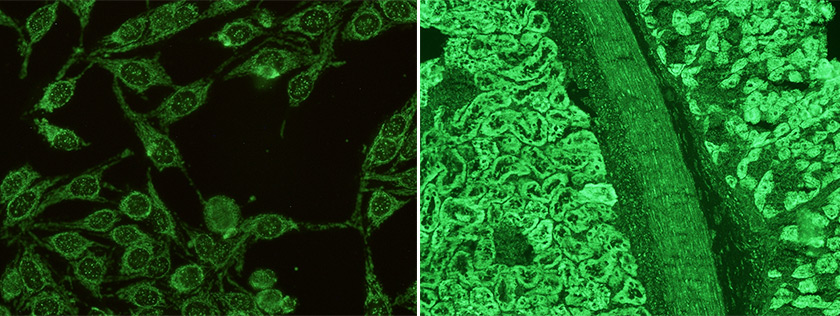
- Utilizes Indirect Immunofluorescence Assay (IFA)
- Detects autoantibodies directed against:
- Mitochondria
- Smooth Muscle
- Parietal Cells
- Supports the diagnosis of autoimmune liver disease, autoimmune gastritis, and related conditions
Refer to the Laboratory Test Directory for detailed specimen collection/transport requirements.