The receptor behind chili-pepper burn may hold clues to pain treatments
By Lisa Howard
New study finds the body's capsaicin receptor, TRPV1, responds differently to varying triggers
(SACRAMENTO)
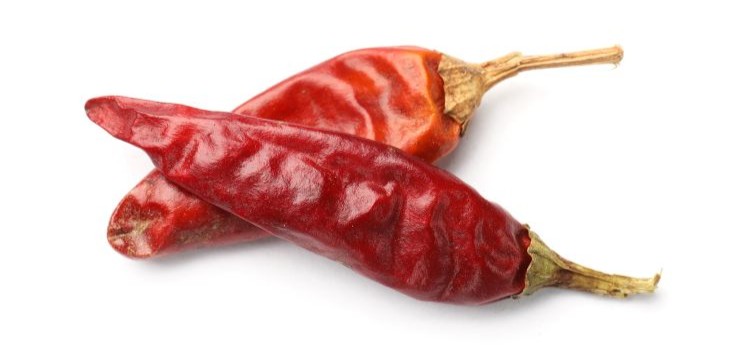
Scientists have long known that capsaicin, the ingredient that makes chili peppers feel hot and is used in some pain-relief creams, works by activating a pain-sensing receptor known as TRPV1.
New research from the UC Davis School of Medicine reveals that the receptor does not respond to every trigger in the same way. Instead, different stimuli appear to place TRPV1 into distinct functional states. The finding opens new possibilities for more targeted pain treatments.
The study, published in PNAS (Proceedings of the National Academy of Sciences), was led by researchers in the UC Davis Department of Physiology and Membrane Biology. The findings challenge a longstanding assumption that TRPV1 adopts a single activated state regardless of what triggers it.
TRPV1 as a potential target for pain medicine
TRPV1 is often called the body's capsaicin receptor. Located on pain-sensing nerve cells, it detects heat, tissue injury, inflammation and chemical compounds — including the capsaicin in hot peppers.
Because TRPV1 plays a central role in pain pathways and does not involve opioid signaling, it has long been considered a potential target for developing nonaddictive pain medicines. However, efforts to block the receptor have been complicated by its equally important role in regulating body temperature.
"Researchers have generally assumed that once TRPV1 is activated, the channel enters essentially the same open state regardless of what stimulus triggered it," said first author Bo Hyun Lee, a former researcher in the Zheng Lab at UC Davis. "Our findings show that the receptor is more sophisticated than that. Different stimuli appear to stabilize different open states, each with distinct functional properties."
Methods measured receptor’s response to different stimuli
To investigate how TRPV1 responds to different stimuli, the researchers measured electrical currents passing through individual channels activated by:
Capsaicin, the compound that gives chili peppers their heat
Resiniferatoxin, an extremely hot compound derived from a succulent plant
Hydrogen ions (protons), which create acidic conditions commonly associated with tissue injury and inflammation
2-APB, a chemical commonly used to modify ion channel activity
Heat
They found that different activators consistently produced different conductance levels. This finding suggests the channel opens in distinct ways rather than entering a common activated state.
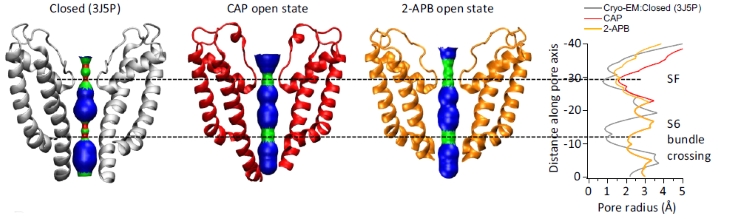
Modeling of the different states of the TRPV1 pore, including closed (left), capsaicin-activated (middle) and 2-APB-activated (right).
The team then combined several approaches to see if those different conductance levels reflected structural differences in the receptor itself.
Using sensitive ion-permeation measurements (which measure how quickly charged particles move across a barrier), the researchers detected evidence that different activators altered the shape of the channel pore. They also used a fluorescence-based technique in living cells that allowed them to watch different parts of the channel protein shift position as it responded to different stimuli.
Finally, computational modeling helped visualize how the receptor's structure changed when activated by different stimuli.
Together, these approaches pointed to the existence of multiple distinct open configurations of TRPV1.
"We were able to see consistent evidence from several independent experimental methods that the pore of the channel does not look exactly the same when activated by different stimuli," said senior author Jie Zheng, professor in the Department of Physiology and Membrane Biology. "That convergence of evidence gave us confidence that these are genuine functional states rather than experimental artifacts."
The researchers also made another unexpected discovery. When two stimuli were applied together, the channel opened more slowly instead of more quickly. The finding suggests that different activation mechanisms may sometimes interfere with one another, revealing an additional layer of complexity in how pain signals are processed.
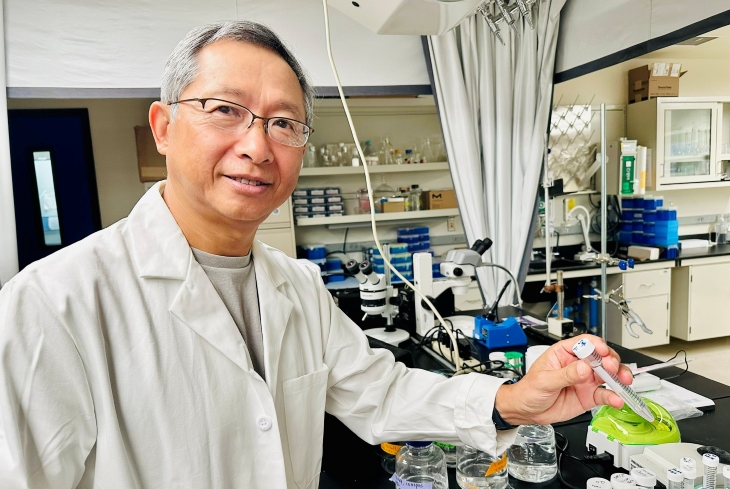
By showing how capsaicin receptors respond to triggers, Jie Zheng hopes to open the door to new pain medicines.
Findings may have implications for pain and basic research
Previous attempts to target TRPV1 with drugs for pain relief have often caused unwanted side effects, including major disruptions in body temperature regulation. The new study suggests it may someday be possible to selectively target receptor states associated with painful stimuli while preserving those involved in normal heat sensation.
"Our study provides a conceptual framework for thinking about TRPV1 in a much more nuanced way," said Vladimir Yarov-Yarovoy, co-author and professor in the Department of Physiology and Membrane Biology. "If different forms of activation produce different functional states, we may eventually be able to design therapies that selectively affect pain-related activity while leaving other essential functions intact."
The study also offers insight into how proteins function when encountering nontypical stimuli.
The work provides a new understanding of one of the body's most important pain sensors. It offers a potential roadmap for developing safer, more precise analgesic therapies. More research is needed to translate the study’s findings into new treatments.
Additional authors include Shisheng Li, Simon Vu, and Zhihao Yao from UC Davis and Yuhua Tian from UC Davis and Qingdao University.
Funding
This study was funded by the National Institutes of Health (R01NS103954) and the Basic Science Research Program through the National Research Foundation of Korea (RS-2023-00212567, RS-2023-00219399).