
Classes
Pediatric Fundamentals Training Program, Day 4 (Critical Care Track)
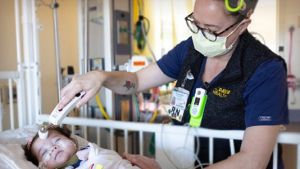
Day 4 of the Pediatric Fundamentals Training Program (PFTP) Critical Care Track focuses on the recognition and management of pediatric respiratory failure and advanced respiratory support in the critically ill child. Through case-based learning, hands-on workshops, skills stations, simulation, and facilitated discussion, participants will explore respiratory physiology, oxygenation versus ventilation failure, status asthmaticus, acute respiratory distress syndrome (ARDS), respiratory support modalities, mechanical ventilation, and arterial blood gas interpretation. Learners will develop skills in respiratory assessment, ventilator management, recognition of clinical deterioration, and evaluation of treatment effectiveness while applying critical care concepts during simulation scenarios involving ARDS and severe asthma exacerbation. By the end of the activity, participants will be able to recognize respiratory failure, assess patient response to respiratory support strategies, and implement appropriate interventions and escalation of care for pediatric patients experiencing respiratory compromise.
This is a blended learning course that consists of two parts. Part 1 consists of online learning modules. Part 2 is the in-person class.
This class is only open to UC Davis Health RNs in the following care areas: D10 PICU/PCICU, T7 MSICU Gold, Pediatric Float Pool, Children’s Hospital Critical Care Transport Team, and the Rapid Response/Action Team.
Part 1: Online Modules
Before attending the in-person class, participants must complete six online modules.
Status Asthmaticus
Code: DAHS-NCHSA25-PLS
Estimated Duration: 54 minutes
Start
Acute Respiratory Distress Syndrome
Code: DAHS-NCHARDS25-PLS
Estimated Duration: 48 minutes
Start
Mechanical Ventilation: Introduction to Pediatric Practices
Code: DAHS-NCHACRP26-PLS
Estimated Duration: 48 minutes
Start
Advanced Concepts in Respiratory Physiology
Code: DAHS-NCHIABGI25-PLS
Estimated Duration: 50 minutes
Start
Introduction to Arterial Blood Gas Interpretation
Code: DAHS-NCHUABG26-PLS
Estimated Duration: 45 minutes
Start
Understanding Abnormal Blood Gases
Code: DAHS-NCHDTT26-PLS
Estimated Duration: 51 minutes
Start
Part 2: In-Person Class
When the online modules are complete, participants will attend an in-person class. Participants must bring verification of the module completion to class. Participants may bring their UC Learning Center training transcript as proof or show their training transcript using the SumTotal Next mobile app.
Center for Health and Technology, Room 3308
4610 X St.
Sacramento, CA 95817
Dates:
Feb. 3, 2027
May 26, 2027
Sept. 22, 2027
Time: 8 a.m. to 4:30 p.m.
Code: DAHS-NCHPFTP26D4CCT-BRN
Capacity: 40
Waiting list: Yes
Attire
Please wear hospital scrubs.
Continuing Education Contact Hours
Provider approved by the California Board of Registered Nursing, provider number CEP 26, for 7.25 contact hours.
Attendees will not receive C.E. credit if they are more than 20 minutes late; no partial credit can be awarded.
The online modules provide independently awarded contact hours through an external accrediting provider. Learners should claim their CE certificate directly through the Pediatric Learning Solutions module within UC Learning Center at the end of each course.
Registration
UC Davis Health Employees
Registration Deposit $25
Register
- Register through the UC Learning Center.
- Call our office at 916-734-9790 to make your deposit by credit card.
Registrations are approved after your deposit is received. Registration deposit is returned upon completion of class.
Cancellation must be requested five days before the class date to receive a deposit refund.
Coordinators
Ashley Donkerbrook, M.S.N., R.N., A.C.C.N.S.-P., C.C.R.N.
Children’s Hospital Nursing Professional Development Specialist
aedonkerbrook@health.ucdavis.edu
Logan Bramble
Health Professions Education Specialist
Parking
Parking is available in lots 16, 17, 22, 30, 30 Auxiliary, and Broadway with either a B permit or daily permit. Daily permits are available for purchase with the ParkMobile app using zone number 42201 or at a parking kiosk. Please visit Parking and Transportation Services for more information.
Special Needs
Individuals needing special accommodations may call the Center for Professional Practice of Nursing at 916-734-9790.
All Are Welcome
UC Davis adheres to California's Proposition 209 which prohibits discrimination against or giving preferential treatment to any individual or group in public employment, public education, or public contracting on the basis of race, sex, color, ethnicity, or national origin.