

Last fall UC Davis Chancellor Gary S. May appointed Mark I. Rosenblatt, M.D., Ph.D., M.B.A., M.H.A., to the position of vice chancellor of human health sciences at UC Davis, which represents the senior executive role for UC Davis Health. Rosenblatt is responsible for overseeing all of the health system’s research, education, and patient care, conducted at centers such as the nationally ranked UC Davis Medical Center, UC Davis Children’s Hospital, UC Davis School of Medicine and Betty Irene Moore School of Nursing at UC Davis.
When he started the role this January, Rosenblatt was already more than a little familiar with UC Davis Health. He actually began his academic career at UC Davis in 2005 as an assistant professor of ophthalmology and vision science, where he split his time between research in Davis and clinical care in Sacramento.
He’s served a variety of academic, research, and executive roles in the roughly two decades since. Before rejoining UC Davis Health, Rosenblatt was most recently the G. Stephen Irwin executive dean at the University of Illinois College of Medicine and chief executive officer of the University of Illinois Hospital and Clinics, where he developed and implemented a comprehensive strategic plan for the hospital and medical school. He was also a distinguished professor of ophthalmology and visual sciences.
As an internationally recognized clinician-scientist, Rosenblatt still leads groups of scientists investigating the mechanism of corneal peripheral nerve regeneration following injury, and the use of nanoengineered biomaterials for use in stem cell delivery to the ocular surface. His research is widely published, with more than 225 original manuscripts, review articles, book chapters and abstracts, including some 150 peer-reviewed publications. His work in regenerative medicine has been funded by the National Institutes of Health, Department of Defense, Research to Prevent Blindness, Falk Family Foundation, and the Tri-Institutional Stem Cell Initiative.
Rosenblatt succeeds David Lubarsky, M.D., M.B.A., F.A.S.A., who retired last year and became president and CEO of Westchester Medical Center Health Network near where he grew up in New York. Bruce Lee Hall, M.D., Ph.D., M.B.A., served as interim vice chancellor of human health sciences before returning to his position as Chief Clinical Officer for UC Davis Health.
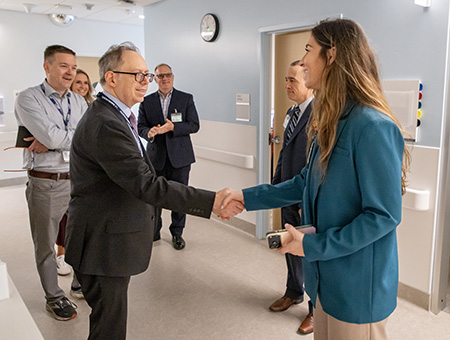
Returning to UC Davis Health on Jan. 19 after two decades, Rosenblatt stepped into leadership at a moment defined by expansion, rising demand and increasing complexity. His early focus has been engagement — meeting teams across the health system and identifying the themes that will shape its next chapter. “I’m incredibly impressed by the people, expertise, compassion and teamwork across UC Davis Health,” he said in April after a first wave of meetings and tours — often in small-group settings – involving faculty, nurses, staff, residents and students.
Rosenblatt called his return to Sacramento “a homecoming.” In interviews, he has described his management philosophy as a servant leadership approach, working to highlight the integration between research, education and clinical operations. And he noted the importance of focusing on the “quintuple aim” of healthcare: improving quality of care; ensuring patient safety; enhancing patient experience; promoting health equity; and supporting caregiver well-being.
What attracted you to UC Davis Health?
I’m so pleased to be back at UC Davis — it feels like coming home. It’s amazing to be back. My very first academic job was here at UC Davis as a junior faculty member — an assistant professor trying to establish my research career, build a laboratory, as well as spend time taking care of patients.
I know how much UC Davis and UC Davis Health mean to Californians. It is such an important fixture, being the only academic medical center in this part of California. It is a huge responsibility, but also of course a huge privilege. And the discoveries that happen here at UC Davis Health are more than just helpful for Californians. These are things that change the world.
And so a chance to be part of such a health system again, and lead it, and work with other talented leaders to make these important things happen — it’s amazing to be able to come back and realize that we can have such an important impact. The people are the secret sauce. It’s the thing that makes UC Davis Health so special.
What are some of your early priorities?
I’m really deeply committed to hearing what’s important to our faculty, our staff, our students and our chair leadership. Although I did have a stint here, they’ve been here a long time. They understand this organization better than I do right now. I’m going to listen, I’m going to learn. And then my job is to help bring all of that together — the various stakeholders, the various viewpoints — to one unified vision. A strategy to make sure that we do the very, very best to meet our missions to deliver great patient care, make discoveries that will change medicine and the lives of patients, and educate the next generation of spectacular physicians and scientists.
My approach has always been to listen. As we do our strategic planning, it’s not going to be my plan — it’s going to be the organization’s plan. It’s going to be the plan of our students, our staff, and, of course, our faculty. Together, we’re much smarter than we are individually, and it’s going to be fun to work with this group. It’s a highly dedicated, highly talented group that will move UC Davis Health forward, and also move academic medicine forward.
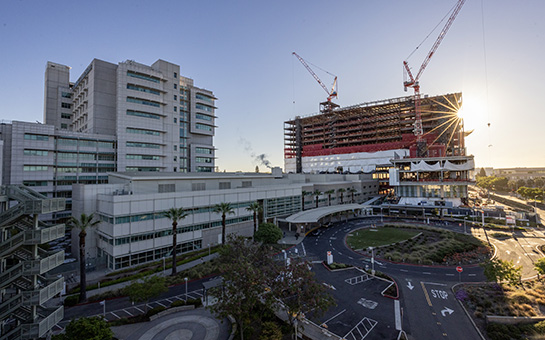
One of my first priorities is also solidifying a permanent leadership team for the coming years. Our selection process is under way for our next School of Medicine dean — and also for our next CEO of UC Davis Health, which is returning to a separate, dedicated position. I want to fill all interim positions with long-term leaders by end of 2026. Stable leadership is important as we head through challenges like the continued uncertainty around financing, the growing number of patients we serve, and the opening of UC Davis Medical Center’s new California Tower in less than 4 years.
You’ve highlighted research as an area of great importance as well.
Research is really fundamental. It’s what makes academic medicine special — making discoveries that can have an impact on patients, making a difference. And so I enjoy being a part of that. It’s really an important part of my identity, and it’s really an important part of the identity of UC Davis Health.
For example, I’m a corneal surgeon, and my research involves the cornea. Corneal injury is a common condition, and when severe can be a blinding and disabling problem. When the nerves of the cornea are damaged, patients may have pain and delays in healing. We are investigating how the eye heals, and how we can use growth factors to allow the cornea to regenerate in a way that avoids vision loss or persistent neuropathic pain.
We’re fortunate to have an NIH-funded laboratory, and we’re moving that laboratory here to UC Davis. Members of my lab are excited about the chance to continue our work here in Sacramento and Davis. There are so many wonderful researchers at UC Davis working in the neurosciences, and I think it’s going to be a boon to the work that we’re doing for the cornea… I’m going to learn a lot from the neuroscientists here, and we’re going to take our NIH-funded research program and continue to work to make sure that we develop new cures, new therapies to treat patients with eye pain.
You’ve mentioned your own research dovetails into some examples of research strengths here, both in terms of specific areas and also the larger collaboration between campuses in Sacramento and Davis.
UC Davis is a leader in neuroscience, and also in regenerative medicine. And my laboratory is looking at neuroregeneration. When the nerves in the cornea are damaged — and this happens in almost any eye disease — it can cause pain, and also cause a lack of wound healing. So we’re interested in finding new molecules, new growth factors that can cause the nerves to grow back in the cornea and do their job. That is, to be pain free, but also cause the wound healing that’s required for normal cornea function.
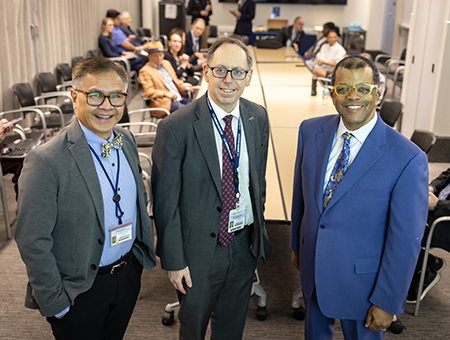
Certainly, much of the important basic and translational research that UC Davis Health produces, the impactful research, is happening in Davis. In fact, during my first time here my laboratory was in Tupper Hall, and I know all the great work that’s happening there.
So collaborations between my lab, researchers both in Sacramento and Davis is going to be profoundly important. And frankly, making sure that connection isn’t just maintained, but also strengthened, is really going to be an important part of my job. My plan is to be at Davis at least one day each week — spending time with leadership, but also having an opportunity to meet with faculty, staff, and students who are spending their time in Davis doing research and being educated.
I’ve also spent time at our new Aggie Square innovation district, which will support research collaboration, industry partnerships and economic development. It’s critical — a big part of the future of the health system depends on the work happening at Aggie Square. Early conversations have included how to attract companies — both domestic and international — and create opportunities for partnership and growth.
Instability in research funding and policy are just two of the many historic challenges facing healthcare today. How do you think UC Davis Health can navigate this time?
We live in a complicated world. We know that there are many pressures that are placed upon academic medicine. That of course includes, broadly, higher education. The important research that happens, and of course the research that happens at UC Davis Health, is important to making impactful discoveries that will change the lives of our patients. And that’s so important, and anything that would erode the ability to do that work affects us all, and really weighs heavily upon us.
I think we have to be creative – and we’re good at being creative. Isn’t innovation, and finding out new ways to do hard things, part of what academic medicine is all about?—Mark Rosenblatt
This great uncertainty (of this time) makes it hard to plan. And planning is important to doing good research. It’s been disruptive. And we have to adapt. We need to make sure that (regarding) the resources we have, that we’re good stewards, that we’re investing them in just the right places. We have to look for new sources of funding, maybe in places we haven’t looked to before. Whether it’s foundations, or whether it’s philanthropy, even industry, perhaps, those collaborations can be important.
So I think we have to be creative — and we’re good at being creative. Isn’t innovation, and finding out new ways to do hard things, part of what academic medicine is all about? And so I look forward to leading this group forward as we make the necessary changes to thrive, even in a time of challenges.
What defines great patient care in your mind?
One of the key principles I’ve always worked under is everyone deserves great access to care. But when they get access, that’s not enough. The care they get has to be world-class. And so it’s really on us to make sure that we can expand access to care to our patients, and our community needs that. The tertiary and quaternary care in particular that an academic medical center like UC Davis Health can provide, can’t often be provided by any other place. And so how do we build that capacity?
I know that there are aggressive plans — and not just plans, but in fact new buildings are being built to make sure we can help meet that demand. And not just buildings that look like old buildings, but new buildings that are designed in ways to provide care in ways that have previously been unimaginable. Smart hospitals, hospitals that are adaptable in the wake of a new pandemic and can quickly turn into a hospital that’s almost entirely an intensive care unit. So, this is something where (these) investments need to be made if we’re to live up to our responsibilities to deliver care to as many patients in the community that need us.
It’s more than just new buildings, though. It’s also about “how can we work differently?” Things like telehealth, providing hospital at home… making sure that when patients get admitted to the hospital, they have a chance to leave more quickly and head back to their homes and a healthy life. So there’s a lot we can do to improve access.
But this is one of the things that does keep me up at night, is how can academic health centers like UC Davis Health care for as many people in the community as possible? Because they really need us.
Can you share your thoughts on another great disrupter in both healthcare and the wider world, artificial intelligence?
The bottom line is that AI is here, it’s here to stay, and it’s something we need to adapt to. I believe our role as an academic health system isn’t to resist AI, but to shape how it’s used in order to benefit our patients, the providers who serve them, and the entire healthcare system. We have to guide the responsible use of AI so that we can ensure there’s human oversight and ethical application, but still allow the technology to contribute to life-saving innovation within those guardrails.
In Chicago, we pursued this by establishing an institute that works to leverage artificial intelligence and machine learning in ways meant to advance fairness and reduce bias in healthcare. It’s called the AI.Health4All Center, and it embraces a community-based participatory research model with the communities surrounding the university. The idea is to support participation, co-learning, and capacity building in research areas where they directly benefit.
Here at UC Davis Health, AI is already saving lives and improving outcomes. There are over 80 AI applications in use in the clinical environment right now.
“We have to guide the responsible use of AI so that we can ensure there’s human oversight and ethical application, but still allow the technology to contribute to lifesaving innovation within those guardrails.”—Mark Rosenblatt
It’s not replacing providers, but acting as a companion to help improve diagnosis, treatment, and the patient experience. It’s aiding in areas like stroke care, sepsis detection, aneurysm detection, surgical decision-making, OR scheduling… Helping to drive faster innovations and better survival rates.
It’s also helping to make the provider experience more sustainable, by saving time on administrative burdens like charting that are important but tedious, and can contribute to burnout. The oversight committee here that monitors AI use includes representation from all perspectives, and especially providers. That’s crucial. The key to successful adoption is creating trust through transparency, and by demonstrating the real-world benefits.
Closing thoughts to share?
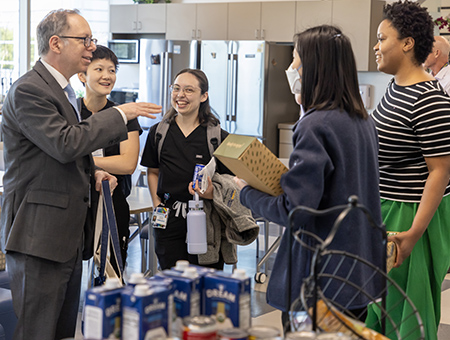
The significance of this moment in time is clear. UC Davis Health is ascending — a large, complex system with growing regional and national impact. This evolution requires new approaches in areas such as leadership, decision-making, and collaboration.
At the same time, it’s clear that preserving the organization’s core values remains essential. This is an important stage in the evolution of UC Davis Health.