
It was around 10 p.m. when Rudolph Avila feared something was wrong — he’d developed a rash, had to urinate every few minutes and couldn’t quench his thirst.
He ended up at UC Davis Medical Center where emergency department staff ordered lab work then made a swift diagnosis: Avila, in his mid-40s and uninsured, had diabetes.
But the next day, his life began to change for the better. And now, 10 years later, junk food is no longer a major part of his routine and his diabetes is diet-controlled without any medication. Most importantly, he has health insurance and a compassionate primary care doctor.
Avila credits his turnaround to a unique partnership between UC Davis Health and the Sacramento County Department of Health Services. The collaboration centers on a program called TEACH — Transforming Education and Community Health. As part of TEACH, a group of UC Davis Health internal medicine residents and their supervisors care for medically underserved patients at the Sacramento County Health Center on Stockton Boulevard and Broadway.
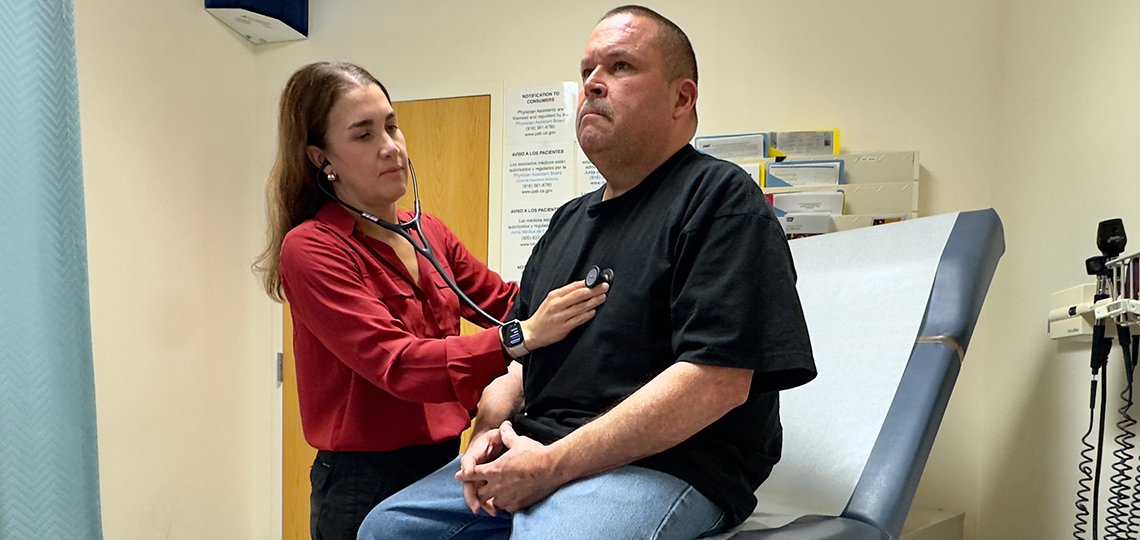
Avila believes that having a solid relationship with his internal medicine physician, Stephany Sánchez, M.D., has made all the difference. “She’s a great doctor, a super doctor,” he said. “She takes care of my needs and my health, and she wants to help me. She says, ‘I’m here for you,’ and she’s always been there.”
Addressing a critical need for 20 years
TEACH started in 2005 to address a critical gap: How best to care for medically vulnerable patients — such as those with limited or no health insurance — after being discharged from UC Davis Medical Center.
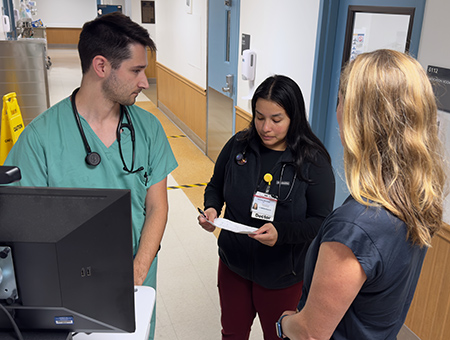
The answer is a community-based partnership in which UC Davis assigns internal medicine residents to provide coordinated, evidence-based, culturally humble primary care to underserved adults. In many cases, the residents will care for the patients in the hospital, then care for them again at their follow-up appointments down the street at the county health center.
“This model not only reduces health disparities but also demonstrates how an academic medical center and a Federally Qualified Health Center can work together to strengthen community health,” said Michael Condrin, UC Davis Health interim chief executive officer.
“TEACH is a powerful expression of our mission to advance health equity, train compassionate physicians and ensure that every patient — regardless of background or income — has access to excellent care.”
A patient’s remarkable transformation
The night of his diagnosis, doctors warned Avila he had been on the verge of slipping into a diabetic coma. They urged him to seek treatment. They made it easy, however, by scheduling an appointment for him at the county health center the next day.
A case worker helped Avila sign up for Medi-Cal, the state’s version of Medicaid, which gave him immediate access to medication, a dietitian, nutrition classes and Sánchez.
“One of the goals of TEACH is to bridge the gap between hospital care and the outpatient setting by helping patients connect with a primary care provider they trust,” said Sánchez, an associate clinical professor at UC Davis Health. “That trusted relationship is key to receiving care early and helping patients stay healthy and out of the hospital.”
Providers eager to care for the medically underserved

Once they have completed their first year, UC Davis internal medicine trainees can apply to TEACH for their final residency year. The five TEACH residents spend consecutive weeks caring for patients in the hospital, followed by weeks seeing outpatients at the county health center. They converse with their patients in English, Spanish, Dari, Pashto, Hmong, Vietnamese and other languages.
“A lot of the TEACH residents either come from an underrepresented background themselves,” Sanchez said, “or have lived in underserved communities so they have a vested interest in serving and working in those communities — giving back.”
Sánchez speaks from experience. She is a former TEACH resident who grew up in El Paso, Texas, surrounded by Mexican-immigrant families that lacked health insurance. She’s now a supervisor and mentor for TEACH residents.
Resident Adriana “Ana” Martinez, now in her TEACH year, received healthcare from free clinics growing up in her East Bay hometown, Hayward. She graduated from UC Berkeley and later decided on a medical career to help patients who are “overlooked,” she said, including those who, like her, were raised in immigrant households.
“TEACH creates a safety net for our vulnerable patients, especially for the ones who don’t navigate the system so easily,” Martinez said.
Changing the face of internal medicine one resident at a time
TEACH has played a pivotal role advancing health equity for thousands of Sacramento County residents, most of them insured by Medi-Cal.
And because the program tends to attract trainees from groups historically underrepresented in medicine, TEACH has helped strengthen the primary care workforce to enhance patient care. Studies show that patients have better health outcomes and are more likely to accept medical recommendations when they share a common background, culture or language with their doctor.
The program was profiled in the New England Journal of Medicine last year for its impressive workforce outcomes. “TEACH graduates have been consistently more likely than their peers to practice general internal medicine and to practice in medically underserved settings,” states the article written by Sánchez and three other UC Davis Health physician leaders deeply connected to TEACH: Heather Vierra, Tonya Fancher and Mark Henderson.
The success of TEACH has also influenced the UC Davis School of Medicine to develop its own pathway, TEACH-MS, for students passionate about caring for urban, underserved patients.