September 11, 2026
The team behind a safe, clean hospital: EVS workers and a shared purpose
Environmental Services employees are mission-oriented in protecting patients, visitors, families
(SACRAMENTO)
Long before a patient enters a hospital room – and often minutes after another patient leaves – an essential member of the UC Davis Health care team goes to work with a keen sense of purpose.
Environmental Services employees, commonly known as EVS, clean and disinfect patient rooms, treatment areas and other spaces throughout the medical center. They respond to spills, handle medical waste and help prepare rooms for the next patient – and that’s just for starters.
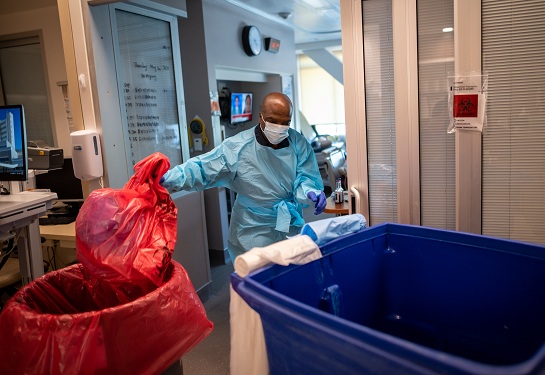
In recent interviews, EVS employees revealed how they find meaning in their work, inspiration in the big picture of their efforts, and connection to UC Davis Health’s culture of patient safety.
With Environmental Services (EVS) Week 2026 taking place from Sept. 13 to Sept. 19, now is a perfect time to shine the spotlight on these vital workers.
Principles into action
At UC Davis Health, maintaining a safe environment is a responsibility shared across the organization. Toward this, Environmental Health and Safety provides expertise and guidance designed to safeguard employees, students and researchers,
EVS employees put those principles into action every day. Their work may sometimes go unnoticed, but the impact is unmistakable.
Dewan Logan, custodian, said, “I wish patients, visitors, and other employees understood just how important Environmental Services is to patient safety, especially in OB/GYN. We aren’t simply cleaning rooms -- we are helping create a safe environment for patients, newborns, families, nurses, physicians, and everyone who enters the space. I take pride in knowing that my work supports the entire health care team.”
Logan added, “We may work behind the scenes, but what we do has a direct impact on patient care.
‘Gives my work purpose’
In a hospital, cleaning is fundamentally different from cleaning most workplaces.
EVS employees work in a complex environment where infection prevention, patient safety and occupational safety are intertwined. Their responsibilities require specialized training, attention to detail, and an understanding of procedures governing everything from disinfecting patient-care areas to handling potentially hazardous materials.
Logan said, “When I walk into a room to clean and prepare it, I think about the person who will be coming into that space next and what they may be experiencing. Because of that, I don’t look at it as simply cleaning a room. I’m preparing an environment where someone’s life may be changing.”
He said he definitively wants the next patient and their family to enter a space that feels clean, safe, comfortable, and ready for them.
“Knowing that gives my work purpose,” Logan said. “I may not be the person providing their medical care, but I know I play a role in creating the environment where that care happens -- and I take that responsibility seriously.”
Emotional role
A sense of humanity is sometimes necessary on the EVS front lines.
Erica Clark, worker 1, recalled being in a patient’s room when that patient received a very negative diagnosis.
“She was devastated and she was crying. Watching her there, I realized for a split second that it was my job to put the mop down and be a friend, a shoulder to cry on, and someone to give her hope and faith.”
Moments like that remind Clark that EVS workers are not just housekeepers. “We to play a huge emotional role in patient care -- giving patients hope, faith and the ability to keep fighting, trying treatments, and recovering.”
Venus Green, custodian, remembered entering a room to do a post-delivery clean-up, and the patient was crying.
She said, “I asked her if I could pray for her, and she says yes. After the prayer she told me that I came in at the right time and that she really needed that prayer.”
Key to the patient care team
EVS employees may not administer medications, perform surgery or make diagnoses, but their work is deeply woven into the full-spectrum delivery of clinical care.
UC Davis Health’s Relationship-Based Culture recognizes that connection. Its philosophy emphasizes that every employee, regardless of discipline, is connected to the purpose and meaning of the organization's work-- specifically citing Environmental Services employees who keep the care environment clean.
That philosophy can be seen in clinical areas throughout the medical center.
In the cardiac electrophysiology laboratory, for example, the multidisciplinary team includes physicians, fellows, nurses, technicians, anesthesia partners and Environmental Services staff. Each has a distinct responsibility, but their work comes together around patient safety.
For EVS workers, that means understanding that the room they clean is not simply another room.
Clark said, “When I was a housekeeper and it was my job to prepare the next room, I would do my best to follow the seven steps. I would try to be very mindful about patients and visitors who would be visiting under a lot of stress.’
She noted, “The last thing I would want is for them to worry about a room not being clean properly.”
Unique place in patient experience
EVS employees also perform terminal cleaning -- the thorough cleaning and disinfection of an area after a patient leaves or, in some circumstances, following construction or maintenance work.
It is detailed work that happens thousands of times across a health system, often behind the scenes.
But each task contributes to the same goal: creating an environment where patients can receive care safely -- while also feeling safe and valued.
Logan said, “In OB/GYN, patients may be coming in for something exciting, such as having a baby, but they may also be experiencing fear, uncertainty, or loss. I try to remember that every person who enters that room deserves to feel respected and cared for. Sometimes a clean room and a kind interaction may seem small, but for a patient going through an emotional moment, those things can mean a lot.
Those interactions give EVS employees a unique place in the patient experience.
Taking care of people
For Clark, the key is to remember environmental services is not just housekeeping.
“We play a key role in safety,” she said.
Clark explained that before any staff or patient goes into a room, it is EVS who must make sure everything is clean and disinfected. The goal is to ensure that every staff member, patient and visitor can go home safely to their family and loved ones.
“Before anyone places a step in that room, we make sure that it is safe to enter,” she added.
As Logan put it, “I’m preparing an environment where someone’s life may be changing.”
Their work is part of a much larger safety culture at UC Davis Health -- one designed to reduce environmental hazards, prevent injuries and maintain an environment that supports patients, visitors and employees.
It is also a reminder that excellent health care depends on far more people than those patients traditionally think of as caregivers.
Behind every clean patient room, sanitized surfaces and safely prepared treatment area is an EVS worker directly supporting the care team.
For UC Davis Health’s Environmental Services employees, keeping the hospital clean isn’t simply about appearances.
It’s about safety. It’s about teamwork. And ultimately, EVS workers are focused on taking care of people.