$1.6 million grant to study ‘sixth’ sense most people have never heard of
By Lisa Howard
Theanne Griffith receives prestigious NSF CAREER Award to investigate how the body's hidden sense of position and movement shape neurodevelopment
(SACRAMENTO)
Most people are familiar with the five senses: sight, hearing, smell, taste and touch. Few realize they have another key “sense” called proprioception, the ability to know where their body and limbs are in space. Without it, even simple actions like walking, reaching for an object or maintaining balance would become extremely difficult.
Theanne Griffith, a neuroscientist at UC Davis Health, has received a prestigious five-year, $1.6 million National Science Foundation (NSF) CAREER Award to investigate how this critical sensory system develops and shapes movement throughout life. The NSF CAREER Award is among the foundation's most competitive honors for early-career faculty, recognizing researchers who excel in both scientific discovery and education.
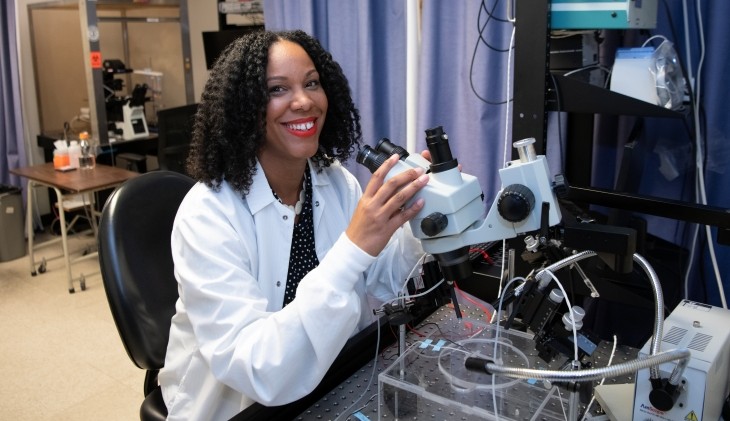
Neuroscientist Theanne Griffith has received a prestigious grant to study proprioception — the nervous system's internal guide for coordinating movement.
Griffith's research focuses on specialized sensory neurons called proprioceptors, which detect changes in muscle movement and force and relay that information to the spinal cord. These signals serve as the nervous system's internal guide for coordinating movement, helping us perform everyday tasks with speed, accuracy and precision.
"Proprioception is one of the most important senses most people have never heard of," Griffith said. "Every step we take depends on our brain and body constantly communicating about where we are in space. I'm excited to explore how that communication develops and what it can teach us about movement, neurodevelopment and neurological disorders."
Research will investigate sodium channels in nerve cells
Her project will investigate how sodium channels, specialized proteins that generate electrical signals in nerve cells, change during development as children acquire increasingly complex motor skills.
While thousands of sodium channel mutations have been identified in people with neurodevelopmental disorders, scientists usually focus on how those mutations affect the brain.
Griffith's work explores a different possibility: that some movement difficulties associated with neurological and developmental disorders may also stem from disruptions in proprioception.
Her laboratory will use a novel genetic approach developed by Griffith that lets researchers study sodium channels in proprioceptors with precision. By examining how these channels function and change during development, the team hopes to uncover new insights into how sensory circuits mature and contribute to healthy movement.
Every step we take depends on our brain and body constantly communicating about where we are in space. I'm excited to explore how that communication develops and what it can teach us about movement, neurodevelopment and neurological disorders.”—Theanne Griffith, associate professor, Department of Physiology and Membrane Biology
Grant will also help develop future scientists
In addition to advancing neuroscience, the award will fund summer research experience for undergraduate students from California State University campuses through UC Davis programs designed to expand access to graduate education and research careers. The emphasis on developing future scientists is a natural extension of Griffith's work. In addition to mentoring students and trainees, Griffith is the author of The Magnificent Makers, a children's book series that encourages young readers to explore science through curiosity, experimentation and discovery.
Griffith said she is excited to inspire the next generation of scientists while supporting discoveries that could reveal how the nervous system develops its remarkable ability to sense and control movement.
This work was supported by federal research funding, which helps transform promising discoveries into real-world breakthroughs that save lives and improve quality of life. Learn more about how public investment in UC Davis research powers innovation, strengthens the economy and advances human health in From Labs to Lives.