


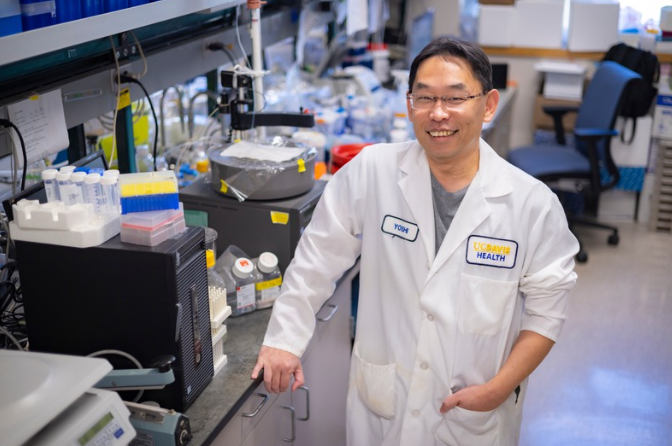
Paving the way for potential new treatments for herpesviruses and cancer
Researcher Yoshihiro Izumiya is a professor in the Department of Dermatology and serves as a staff research scientist at the cancer center. His lab studies virus-host interactions, focusing on how herpesviruses shift from dormant to active replication, often resulting in diseases.
Many viruses produce an acute infection in the human host and are then cleared by the immune system. However, other viruses, especially herpesvirus, remain in the infected person by producing a chronic latent infection. In latent infection, the herpesvirus hides from the immune system by silencing their own gene expression and no infectious virus can be detected during latency. The virus can be reactivated with different external stimuli and will then activate hundreds of gene expressions in cascade fashion; this provides a compelling model to study movement and regulation from “silenced chromatin” to “active chromatin” of host genome.
One disease caused by activation of herpesvirus is Kaposi’s sarcoma-associated herpesvirus (KSHV). Kaposi's sarcoma (KS) is a type of cancer that can form masses on the skin, in lymph nodes, in the mouth, or in other organs. Izumiya is studying how herpesviruses, like the one that causes Kaposi’s sarcoma, behave inside the body. These viruses are tricky—they can hide quietly for years and then suddenly reactivate, causing serious diseases.
The big idea? Use the virus’s own tricks against it to protect people from cancer. As he explained in a profile on his work in November 2024: “The key to identify a therapeutic approach for KSHV-associated diseases lies in understanding when and how KSHV starts to replicate from dormant viral chromatins. We’re trying to uncover the mechanisms behind this shift and focus on how the host inflammation supports KSHV replication and disease development cycles.”
Izumiya’s team is trying to understand how viruses stay dormant without being completely silenced in host cells and develop:
- Novel cancer drugs with viral-host interaction as staring points
- New gene therapy vector specific to herpesvirus-mediated cancers