

Extracorporeal Life Support | UC Davis Health

Extracorporeal Life Support Program

Supporting patients through critical illness.

Extracorporeal Life Support Program

Extracorporeal Life Support Program

Since 2005, the Extracorporeal Life Support Program at UC Davis Health has delivered advanced, lifesaving care for patients of all ages with severe heart or lung failure.

Using extracorporeal membrane oxygenation (ECMO), we support critically ill neonates, children, and adults when conventional therapies are no longer enough. Our multidisciplinary team of intensivists, surgeons, perfusionists, and nurse ECMO specialists work with UC Davis Health’s comprehensive services to provide 24/7 rapid ECMO deployment, continuous bedside care, and coordinated support across the lifespan as a bridge to recovery, transplant, or long-term therapies.

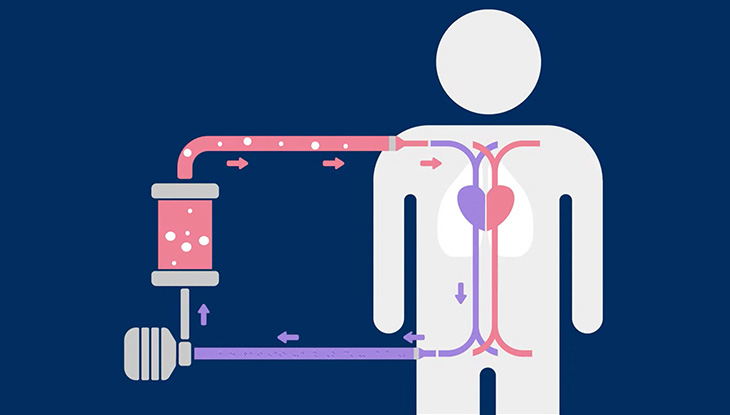
ECMO stands for Extracorporeal Membrane Oxygenation and is also referred to as Extracorporeal Life Support (ECLS). It’s a special type of life support used for people whose heart and/or lungs are so sick or injured that they can’t do their jobs properly, even with the help of a ventilator or strong medicines.

Here’s an easy way to think about it:

“Extra” + “corporeal” = outside the body.

“Membrane” = a special filter.

“Oxygenation” = adding oxygen.

So, ECMO is a machine outside the body that takes over the work of the lungs (and sometimes the heart) for a period of time while they heal.

Watch Videovideo iconIllustratioin depicting patient connected to extracorporeal membrane oxygenation

Blood is taken out of the body through a tube, sent through the ECMO machine, where carbon dioxide is removed and oxygen is added, just like healthy lungs would do. The machine then pumps the oxygen-rich blood back into the body.

ECMO is used when someone has a severe illness or injury—like very bad pneumonia, heart failure, or after major surgery—and other treatments aren’t enough. ECMO doesn’t “fix” the underlying problem; it gives the heart and lungs time to rest and heal.

When a loved one is placed on ECMO, it can feel overwhelming and even frightening. Patients are cared for in either our Pediatric Intensive Care Unit (PICU) or Cardiothoracic Intensive Care Unit (CTICU) depending on their age. They will be surrounded by monitors, tubes, and machines. While this environment may look intimidating, it allows our medical team to watch them closely at all times. A highly trained group of doctors, nurses, and specialists will be with your loved one around the clock, making sure the ECMO machine and all other treatments are working properly.

ECMO itself does not cure the heart or lungs — it gives them time to rest and heal while other treatments continue. Large tubes, called cannulas, connect the patient to the ECMO machine. These are usually placed in the neck, chest, or groin. Many patients are kept asleep with medicines so they don’t feel pain or stress, though in some cases people may be more awake. Families may notice swelling, bruising near the tubes, and frequent beeping sounds from monitors — all of which are common in this setting.

Every patient’s journey on ECMO is different. Some need support for only a few days, while others may require weeks. Recovery is rarely a straight path; there may be hopeful progress one day and setbacks the next. Because of this, it’s normal for doctors and nurses to be unable to predict exactly how long ECMO will be needed or what the final outcome will be.

This uncertainty can be one of the hardest parts for families. Many experience fear, anxiety, and emotional ups and downs while waiting. It can also be exhausting to spend long hours at the hospital. Remember that these feelings are normal, and you are not alone. UC Davis Health is here not only for the patient but also to support families. Social workers, chaplains, and counselors are often available if you need someone to talk to.

Families can help by staying connected — visiting, talking to, and gently touching their loved one. Even if the patient is sedated, your voice may be comforting. At the same time, it’s important to care for yourself: rest, eat, and take breaks when needed. Lean on support, ask questions, and hold onto hope. ECMO is only used when doctors believe there is a chance for recovery.

Being on ECMO itself does not cause pain, though patients are given medicines to keep them comfortable. Many patients are sedated (kept asleep) so they do not feel the large tubes going into their blood vessels during ECMO cannula placement. Even if a patient is more awake, the team uses pain relief and calming medicines to make sure they are as comfortable as possible. Families may see a lot of equipment, but the care team is always focused on preventing pain and distress.

Like any powerful medical treatment, ECMO does carry risks. The most common risks include:

  • Bleeding: Because patients on ECMO receive blood thinners to prevent clots, they can sometimes bleed more easily, whether inside the body or at the sites where tubes are placed.

  • Clots: Even with blood thinners, clots can still form in the machine or in the patient’s body, which can block blood flow.

  • Infections: The large tubes and long ICU stay increase the chance of infection.

  • Stroke or brain injury: Clots or bleeding can affect the brain, which may lead to serious complications.

  • Machine problems: Very rarely, issues with the machine itself can cause sudden risks, though staff are trained to act quickly if this happens.

It’s important to remember that these risks are weighed carefully against the benefits. Doctors only recommend ECMO when someone is so sick that standard treatments are not enough, and when there is a real chance that ECMO could give the heart or lungs time to recover.

Whether someone can eat, drink, or talk while on ECMO depends on how sick they are, how the machine is connected, and what other treatments they need.

Most patients on ECMO are very ill and are kept asleep with medicines, called sedation. This means they are usually not awake enough to eat, drink, or speak. In these cases, nutrition is given in other ways — either through a feeding tube that goes into the stomach or through an IV that delivers nutrients directly into the bloodstream. This ensures the body still gets the energy and strength it needs to heal.

For patients who are more awake on ECMO, eating and drinking can sometimes be possible, but it must be carefully decided by the medical team. Because the breathing tube or other equipment may be in place, swallowing food and liquids isn’t always safe. The care team may bring in specialists, like speech or swallowing therapists, to check if eating and drinking can be done safely.

Talking is also often limited. If a breathing tube is in place, patients cannot speak in the usual way. However, some patients may be able to whisper, mouth words, or communicate with hand signals or writing. In certain situations, doctors may use a special type of breathing tube that allows some speech, but this is not always possible.

In most cases, people on ECMO are too sick to get out of bed. The tubes that connect the patient to the machine are large, delicate, and placed in major blood vessels. Because of this, moving around too much can be risky, and many patients need to stay in bed while the machine does the work of the heart and lungs. As patients improve, carefully supervised movement may be possible. For patients who cannot get out of bed, the ICU team still helps with exercises to keep the body as strong as possible. This may include gentle stretching, leg and arm movements, and sometimes physical and occupational therapists visiting the bedside. 

The length of time someone needs ECMO is different for every patient. Some people only require support for a few days, while others may need it for several weeks. The purpose of ECMO is to give the heart and lungs time to rest and heal, and that timeline depends on the illness or injury being treated and how the body responds.

While on ECMO, the medical team constantly monitors the patient’s recovery with blood tests, X-rays, ultrasounds, and other tools. When there are signs of improvement, the doctors may perform a “trial off” or “weaning trial.” During this test, the ECMO machine is turned down to see if the heart and lungs can handle more of the work on their own. If the patient’s oxygen levels, blood pressure, and other vital signs remain stable, it’s a good sign that ECMO may no longer be needed.

If things go well, the ECMO cannulas (tubes) are removed, and the patient continues recovery with other support, such as a ventilator, medicines, or rehabilitation. However, if the trial shows that the body is not yet ready, which is not uncommon, the patient may go back on ECMO for a few more days. In some cases, doctors may transition to longer-term options, such as a ventricular assist device (VAD) or even organ transplantation, if the heart or lungs are too damaged to recover on their own.

There are also times when ECMO is not helping a patient improve. If the heart and lungs continue to deteriorate despite all efforts, and it becomes clear that ECMO is not achieving the patient’s care goals, the medical team will have several open and compassionate discussions with the family. In this situation, the decision may be made to stop ECMO, and in most cases, the patient will pass away. During these deeply difficult times, the entire medical team — including palliative care specialists, social workers, and chaplains — are available to support patients and families emotionally, spiritually, and practically.

Extracorporeal Life Support Organization logo

Gold Center of Excellence

Recognized as a Gold Center of Excellence by the Extracorporeal Life Support Organization through 2027, we measure our outcomes against international standards and contribute to ongoing research aimed at improving patient survival and recovery. Guided by UC Davis Health's academic mission, we continue to drive innovation in safer, more effective anticoagulation strategies, as well as early mobilization and rehabilitation for patients undergoing ECMO care.