Ankle Replacement Surgery
Our surgeons offer total ankle arthroplasty to help realign your ankle, relieve pain and maintain your range of motion.
Medically reviewed by Christopher Kreulen on Sep. 28, 2026.
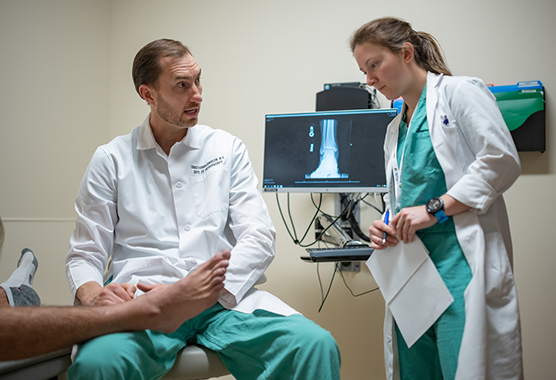
Fellowship-Trained Experts in Ankle Replacement Surgery
Ankle replacement surgery, also called total ankle arthroplasty, is a treatment for severe ankle arthritis, a type of joint disorder. Arthritis makes cartilage in your ankle break down, and activities like walking become painful. Ankle replacement can help you feel better and your ankle move better, letting you get back to your everyday activities.
We understand how frustrating and limiting ankle pain can be. It can affect your ability to walk, work or enjoy daily life. The foot and ankle specialists at UC Davis Health are fellowship-trained orthopaedic surgeons. We have expertise in both nonsurgical and surgical treatments for foot and ankle conditions.
Our team offers total ankle replacement, a procedure to replace the damaged parts of your ankle joint with an implant. Your physician may recommend ankle replacement surgery if nonsurgical treatment options don’t relieve your arthritis symptoms.
On this page
Advantages of Total Ankle Arthroplasty
Ankle pain from arthritis can make everyday activities harder. Ankle replacement surgery is a modern treatment option for severe osteoarthritis, offering several benefits.
Improved Mobility and Function
An implant lets your ankle joint move smoothly and naturally.
Pain Relief
Ankle replacement relieves joint inflammation and damage from arthritis, easing painful symptoms.
Preserved Ankle Motion
With an ankle implant, you can walk more naturally than with other surgical options such as ankle fusion.
Reduced Stress on Other Joints
Easier movement in your ankle helps reduce the stress on nearby joints in your foot, which lowers the chance of arthritis in those joints.
Request an Appointment
As Sacramento's No. 1 hospital, you'll benefit from unique advantages in primary care and specialty care. This includes prevention, diagnosis and treatment options from experts in 150 specialties.
Referring Physicians
To refer a patient, submit an electronic referral form or call.
Patients
Call to make an appointment.
Consumer Resource Center
What to Expect
Total ankle replacement surgery is usually an inpatient procedure, and you will spend at least one night recovering in the hospital. Your care team will talk to you about how to prepare for your procedure and give you instructions for home care. Following the instructions will help you have a better outcome.
-
During the Procedure
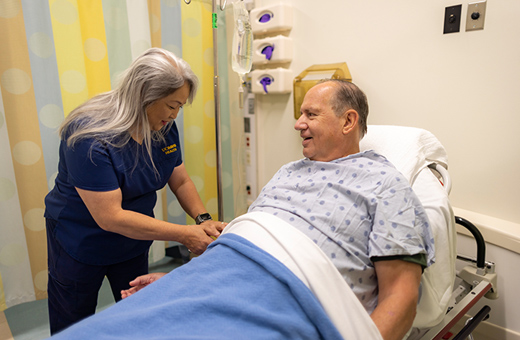
Most people have total ankle replacement under general anesthesia, which means they are asleep during the procedure and feel no pain. Some people may receive regional anesthesia, which numbs the lower half of your body. Your anesthesia team will discuss the safest option for you.
-
During Surgery
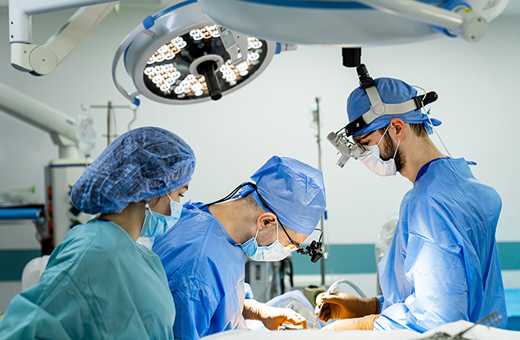
Your surgeon places a tourniquet around your leg to temporarily stop the blood flow to your ankle. They make small incisions in your ankle and use special surgical tools to remove damaged bone and cartilage. Your surgeon places metal and plastic implant parts into your ankle to create a new joint. They use a special glue, bone grafts and screws to support your ankle before closing the incision with stitches or staples.
-

After the Procedure
You will wake up with your ankle in a splint or cast. You will spend at least one night in the hospital with your foot elevated to control swelling and help your wounds heal. You will not be able to put weight on your foot or ankle for up to 6-8 weeks.
Home Care
Your care team will discuss specific instructions for you for wound care and recovery at home.
Elevate Your Leg
You will need to keep your leg elevated as much as possible to reduce swelling and speed healing.
Keep Weight Off Your Foot
You will not put weight on your foot and ankle for up to six weeks after surgery. During this time, you can use crutches, a walker or a knee scooter to move around.
Physical Therapy
After four to six weeks, you will start to put a little weight on your foot. Your provider will recommend you begin physical therapy to continue your recovery and regain strength and movement.
Awards and Recognitions

Ranked among the best in 6 specialties
A U.S. News & World Report best hospital in cancer care, cardiology, heart & vascular surgery, geriatrics, neurology & neurosurgery, orthopedics, and pulmonology & lung surgery.

Ranked among the nation’s best children’s hospitals
U.S. News & World Report ranked UC Davis Children’s Hospital among the best in pediatric nephrology, orthopedics*, and neonatology. (*Together with Shriners Children’s Northern California)

Ranked Sacramento’s #1 hospital
Ranked Sacramento’s #1 hospital by U.S. News, and recognized in 23 types of care including acute kidney failure, cancer care, cardiology, heart & vascular surgery, COPD, colon cancer surgery, diabetes, diabetes & endocrinology, ear, nose & throat surgery, gastroenterology & GI surgery, geriatrics, gynecological cancer surgery, heart arrhythmia, heart attack, heart failure, hip fracture, hip replacement, leukemia, lymphoma & myeloma, lung cancer surgery, neurology & neurosurgery, orthopedics, pneumonia, pulmonology & lung surgery and stroke.
The nation’s highest nursing honor
UC Davis Medical Center has received Magnet® recognition, the nation’s highest honor for nursing excellence.
World-class cancer care
One of ~59 U.S. cancer centers designated “comprehensive” by the National Cancer Institute.

A leader in health care equality
For the 13th consecutive year, UC Davis Medical Center has been recognized as an LGBTQ+ Healthcare Equality Leader by the educational arm of America’s largest civil rights organization.
Latest Orthopaedics News