
Eye Care
Age-Related Macular Degeneration
Age-related macular degeneration (AMD) is the leading cause of vision loss in older adults. We offer expert care to protect your eyesight.
Medically reviewed by Susanna Park, M.D. on April 23, 2026.
What Is Age-Related Macular Degeneration?
Age-related macular degeneration (AMD) is a common cause of vision loss in people 50 and older. Macula is the retina at the back of your eyeball and important for clear central vision. It helps you see clearly to do things like read and drive.
Any change to your vision is concerning. At UC Davis Health, you receive care from nationally recognized eye doctors and surgeons (ophthalmologists) specializing in complex eye diseases. We offer the latest AMD treatments to protect your eyes.
On this page
Types of AMD
There are two main types of AMD:
Dry AMD
This more common type occurs when the macula gets slowly less healthy. Vision may be normal at first but can gradually worsen. Your doctor can see tiny deposits of proteins and lipids (drusen) on an exam to help with diagnosis.
Wet AMD
This more serious type occurs when new, abnormal blood vessels grow in your macula. Blood and other fluids can leak out from these abnormal vessels to the macula and cause sudden vision loss. This condition can develop anytime in patients with AMD and requires prompt treatment to minimize further vision loss.
Symptoms of Age-Related Macular Degeneration
In its early stage, AMD may not cause noticeable symptoms. However, symptoms become gradually more apparent as the condition worsens.
Common Symptoms
Signs of late-stage, advanced AMD include:
- Blurred or fuzzy vision
- Colors that appear washed out or faded
- Difficulty seeing in dimly lit areas
- Gray or blank area in your center of vision
- Objects and straight lines look wavy, crooked or distorted
- Trouble reading, driving or seeing things close up
Causes and Risk Factors of AMD
AMD results in damage to macula the provides clear central vision. Certain factors put you at risk for AMD, including.
Age and Race
AMD is more common in white people, ages 50 and older.
Diet
A diet high in saturated fat and processed foods may increase your risk.
Excess Weight
People with obesity are more likely to have AMD.
Family History
AMD can affect members of the same family.
Health Conditions
People with heart disease, high blood pressure and high cholesterol are more prone to AMD.
Smoking
Smoking increases risk of vision loss from AMD.
Diagnosis and Testing for AMD
Regular eye exams can detect AMD early before vision loss starts. You can get treatments sooner to help protect your vision.
Amsler Grid Test
You identify lines or sections on a grid that look blurry, wavy or broken. This test can be done at home to make sure AMD is not worsening your vision.
Dilated Eye Exam
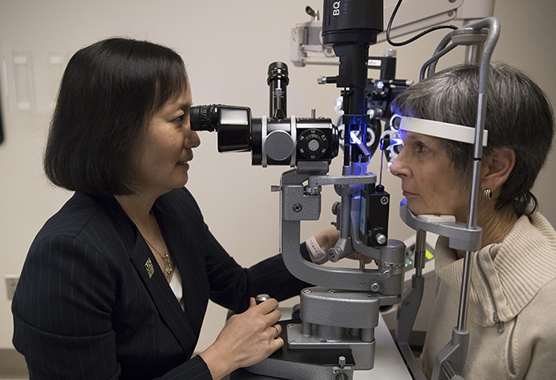
You get dilating eye drops to enlarge your pupil so that your eye doctor can examine your macula and retina.
Fluorescein Angiography
A dye is injected into a vein in your arm, and a special camera tracks the dye as it moves through blood vessels in your retina. The test can help diagnose wet AMD.
Optical Coherence Tomography (OCT)
This machine quickly scans your retina to provide cross-sectional images of the retina and macula.
Optical Coherence Tomography Angiography (OCTA)
This machine quickly scans your retina to provide blood flow information in your macula, similar to fluorescein angiography. However, this test is quicker and no dye is injected. It is sometimes used to diagnose wet AMD.
Treatments for Age-Related Macular Degeneration
There isn’t a cure for AMD. Treatments can minimize worsening of AMD and help protect your vision for longer.
Anti-Vascular Endothelial Growth Factor (Anti-VEGF) Treatment
Eye injections of anti-VEGF medication slow or stop leaking from blood vessels into your macula if you have wet AMD.
Laser Photocoagulation (“Hot Laser”)
Your provider may use a laser to seal or destroy leaking blood vessels in the eye if you have certain type of wet AMD.
Nutritional Therapy
Taking a certain combination of antioxidants, vitamins and minerals can reduce your chances of AMD progressing to an advanced stage. Your eye provider may recommend this supplement combination, depending on the severity of your AMD.
Photodynamic Therapy (“Cold Laser”)
In this special laser treatment for wet AMD, a light-sensitive drug is injected into a vein in your arm. The drug makes the abnormal vessels in your macula more sensitive to the laser applied to the macula by your eye doctor.
Prevention of Age-Related Macular Degeneration
Certain actions may lower your risk of vision loss from AMD.
Achieve and Maintain a Healthy Weight
Losing excess weight, especially around your middle section, can lower your risk of vision loss from AMD.
Eat a Healthy Diet
Eat more fruits, vegetables, beans and fish. Talk to your provider about whether you need supplements.
Exercise Regularly
Being physically active is good for your blood vessels and your eyes.
Manage Health Conditions
Take medications to manage high blood pressure and high cholesterol.
Protect Your Eyes
Wear sunglasses that protect eyes against ultraviolet light.
Quit Smoking and Vaping
Talk to your provider about ways to quit smoking.
An estimated
20MAmericans have AMD.
As many as
8 in 10People with AMD have dry AMD.
Sources: JAMA: Age-Related Macular Degeneration: A Review
American Academy of Ophthalmology: Understanding Macular Degeneration
Request an Appointment
As Sacramento's No. 1 hospital, you'll benefit from unique advantages in primary care and specialty care. This includes prevention, diagnosis and treatment options from experts in 150 specialties.
Referring Physicians
To refer a patient, submit an electronic referral form or call.
Patients
Call to make an appointment.
Consumer Resource Center
Awards and Recognitions
Ranked among the best in 6 specialties
A U.S. News & World Report best hospital in cancer care, cardiology, heart & vascular surgery, geriatrics, neurology & neurosurgery, orthopedics, and pulmonology & lung surgery.
Ranked among the nation’s best children’s hospitals
U.S. News & World Report ranked UC Davis Children’s Hospital among the best in pediatric nephrology, orthopedics*, and neonatology. (*Together with Shriners Children’s Northern California)
Ranked Sacramento’s #1 hospital
Ranked Sacramento’s #1 hospital by U.S. News, and recognized in 23 types of care including acute kidney failure, cancer care, cardiology, heart & vascular surgery, COPD, colon cancer surgery, diabetes, diabetes & endocrinology, ear, nose & throat surgery, gastroenterology & GI surgery, geriatrics, gynecological cancer surgery, heart arrhythmia, heart attack, heart failure, hip fracture, hip replacement, leukemia, lymphoma & myeloma, lung cancer surgery, neurology & neurosurgery, orthopedics, pneumonia, pulmonology & lung surgery and stroke.
The nation’s highest nursing honor
UC Davis Medical Center has received Magnet® recognition, the nation’s highest honor for nursing excellence.
World-class cancer care
One of ~59 U.S. cancer centers designated “comprehensive” by the National Cancer Institute.

A leader in health care equality
For the 13th consecutive year, UC Davis Medical Center has been recognized as an LGBTQ+ Healthcare Equality Leader by the educational arm of America’s largest civil rights organization.
Latest Eye Health News
