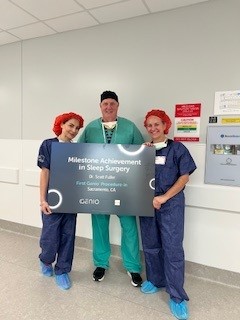
UC Davis Health performs Northern California’s first procedure with new hypoglossal nerve stimulation device
By Liam Connolly
Minimally invasive approach expands treatment options for people with moderate to severe obstructive sleep apnea
(SACRAMENTO)
UC Davis Medical Center has become the first hospital in Northern California to treat patients with moderate to severe obstructive sleep apnea (OSA) by using an innovative hypoglossal nerve stimulation (HGNS) device.
The Genio system, recently approved by the U.S. Food and Drug Administration (FDA), offers a unique approach to OSA by stimulating the hypoglossal nerve bilaterally to maintain an open airway during sleep. It is also the only HGNS device clinically proven to work in the supine position, while users are sleeping on their backs, a position in which OSA symptoms are often most severe.
Scott Fuller and his team were the first in Northern California to treat a patient with severe obstructive sleep apnea by using the Genio system.
The device features a battery-free implant that is placed through a single incision beneath the chin, in an outpatient setting. It’s powered by a small external battery connected to a disposable adhesive patch worn on the skin under the chin. The implant, which stimulates the tongue muscles, has been deemed safe for most full body MRI scans.
“We’re excited to offer patients this newly FDA-approved bilateral implant, which has been used in Europe for several years with comparable efficacy data,” said Scott Fuller, professor of Otolaryngology, who performed the first procedure at UC Davis Health. “While the core principle of neurostimulation remains the same, the new implant is reported to be more effective for positional sleep apnea. It also provides a platform that avoids additional surgery for battery replacement and overcomes MRI compatibility limitations seen with other devices.”
Moderate-to-severe OSA affects nearly half a billion people globally and is linked to serious health issues, including cardiovascular disease, stroke, diabetes and cognitive decline. By improving airflow and reducing nighttime disruptions, patients enjoy more restful sleep and experience better long-term health outcomes.
A national leader in obstructive sleep apnea treatment
UC Davis Health has long been a pioneer in obstructive sleep apnea treatment helping patients manage CPAP failure.
“The UC Davis Otolaryngology team is among the most advanced and comprehensive in the nation,” added Fuller. “Our commitment to delivering complete, efficient and high-quality care drives our leadership in this field.”