
Rethinking how health research is done
The T32 ReACH program trains UC Davis nursing doctoral students to address disparities through people-centered science
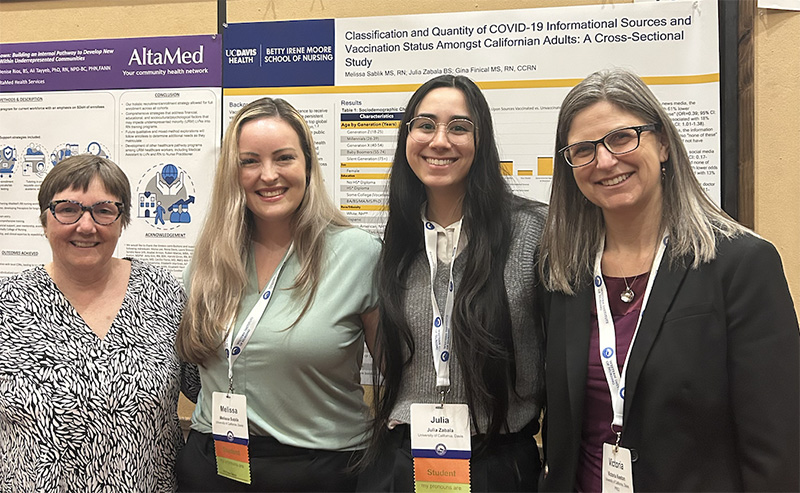
Third-year Ph.D. student Julia Zabala shares how the ReACH program changed the trajectory of her research.
Julia Zabala did not plan on earning a Doctor of Philosophy (Ph.D.) degree. She did not plan on joining a school of nursing. And she certainly did not expect that her research would one day focus on neighborhoods, green space and the long shadows of history.
“Absolutely not,” she said, when asked if she ever imagined herself in a nursing Ph.D. program.
Today, she is a third-year doctoral student and trainee in a program called T32 ReACH (Research to Advance Community and Connected Health Equity) at the Betty Irene Moore School of Nursing at UC Davis. Her career path, like many influenced by the program, has been defined less by a straight line and more by curiosity, support and a growing understanding of how health is shaped long before someone enters a clinic.
Data changes when focus does
“The one power everyone has is how they engage in their day to day. That’s where we have power to make change that supports equitable futures for everyone.”
– Julia Zabala, Ph.D. in Nursing Science and Health-Care Leadership student
ReACH is a federally funded training program to support doctoral students in studying science grounded in how people actually live, work and access care using advanced, people-centered research methods. This research is aimed at better results for all groups of people.
The need for that focus is not new. More than 20 years ago, national experts warned that health disparities were deeply embedded in the U.S. health care system. According to program lead Professor Leigh Ann Simmons, the data today look much the same.
“That’s why we really can’t shy away from having dedicated training programs in this topic area,” Simmons said.
This type of research asks different questions — not only about outcomes, but about context. Research consistently shows that social and structural factors such as housing, income, environmental exposure and neighborhood conditions play a major role in health outcomes. Communities that have faced decades of disinvestment often experience higher rates of chronic illness, worse maternal health outcomes and shorter life expectancy.
Moving beyond the numbers to see real people
Zabala’s research grew directly out of that understanding. Her dissertation explores the relationship between residential greenery and health outcomes in Sacramento neighborhoods, using advanced data analysis. But one of the most formative experiences shaping her work did not take place in a classroom or lab.
As part of the ReACH program, she joined a multi-day bus tour of California’s Central Valley, visiting communities with environmental and economic imbalances.
“The bus tour further solidified the humans behind the data points,” she said. “It made the histories real.”
The experience also sparked personal discovery. Zabala learned that her grandfather had worked in Central Valley agricultural fields. She was unaware of that part of her family’s history. The past, she realized, was not abstract. It was present in people, places and policies still shaping health today.
That kind of learning is intentional, Simmons said.
“The one power everyone has is how they engage in their day to day,” she said. “That’s where we have power to make change that supports equitable futures for everyone.”
Approaching problem through many lenses
A defining feature of ReACH is its interdisciplinary approach. Students come from nursing, environmental science, social science and other fields. At UC Davis, Simmons said, that breadth allows students to pursue complex questions surrounded by the right expertise.
That flexibility mattered for Zabala. Her research interests evolved, and the program evolved with her.
“The ReACH program absolutely has changed my trajectory within this program for the better,” she said. “It’s a place where exploration is not just allowed, it’s encouraged.”
Just as important is the community ReACH builds. Doctoral programs can be isolating, Zabala said, but her cohort became a source of support and perspective.
“I would say health equity research is research that takes into account the context and histories of those who have been marginalized,” she said, “and designs research that uplifts rather than sustains layers of oppression.”
ReACH offers more than training for students drawn to that work. It offers a way to ask better questions and to remember who those questions are meant to serve.