
Betty Irene Moore Fellowship awards six Next Steps Grants to support nurse leaders’ research
June 5, 2026
By Megan Hansen
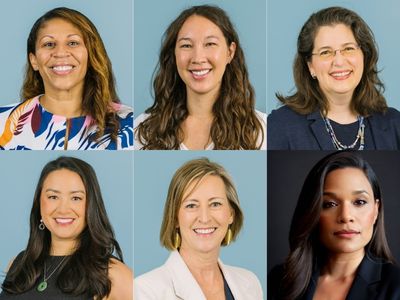 Betty Irene Moore Fellows (pictured from left to right and top to bottom) Dawn Bounds, Kristen Choi, Kristen Fessele, Michelle Litchman, Sheridan Miyamoto and Kimberly Souffront are receiving Next Steps Grants to expand their fellowship research.
Six nurse leaders in the Betty Irene Moore Fellowship for Nurse Leaders and Innovators program are receiving additional grant funding to expand their fellowship research and further amplify their impact on health care and their communities. Each award provides up to $150,000 in funding over 18 months.
The Next Steps Grants, which begin July 1, bridge support to further advance fellowship projects. The grants are part of the fellowship’s new Innovation Funding Program, an initiative designed to support projects that generate new ideas, strengthen collaboration and lay the groundwork for lasting improvements in health and health care systems.
Funded through the fellowship grant from the Gordon and Betty Moore Foundation and made possible through careful stewardship of program resources, the national program office is reinvesting remaining funds to further support fellows advancing leadership in nursing science, practice, education, policy and entrepreneurship.
“This program advances Betty Irene Moore’s vision of elevating and supporting promising nurse leaders,” said Heather M. Young, national program director for the fellowship. “We are delighted to fund six outstanding projects that will deepen fellows’ work, spark new insights and translate research into meaningful improvements in health care and community well-being.”
Next Steps Grant awardees:
- Dawn Bounds, 2022 cohort fellow from UCI Sue and Bill Gross School of Nursing: Her project aims to engage youth as co‑researchers to examine how generative artificial intelligence (AI) affects their mental health information seeking and social‑emotional wellbeing. Her goal is to then co‑design a safe, youth‑driven AI‑use intervention using focus groups, a national survey and human‑centered design.
- Kristen Choi, 2022 cohort fellow from UCLA School of Nursing: Her project evaluates whether psychiatric mental health nurse practitioners (PMHNPs) can help address the child mental health care provider shortage by comparing the quality and outcomes of care they deliver versus those of physicians. Using statewide insurance claims data, the study examines differences in patient populations, care quality and preventable high-cost services to generate evidence for scaling PMHNP-led care models.
- Kristen Fessele, 2022 cohort fellow from Memorial Sloan Kettering Cancer Center: Her project aims to co-design and test a personalized, multimodal large language model learning agent to deliver tailored health promotion coaching to older adults living with cancer, addressing low engagement and diverse needs. Through participatory design and prototype testing, she creates an adaptive digital system that personalizes content, delivery and coaching to improve health outcomes and scalability of interventions.
- Michelle Litchman, 2021 cohort fellow from University of Utah College of Nursing: Her project aims to develop a sustainability model to translate a telehealth diabetes education program for Deaf and hard-of-hearing individuals from research into real-world practice. The model engages partners to assess readiness, expand training for ASL-fluent providers and co-create a scalable blueprint for long-term national implementation.
- Sheridan Miyamoto, 2020 cohort fellow from Penn State Ross and Carol Nese College of Nursing: Her project aims to develop and evaluate a Forensic Nurse Leadership Academy to train and support nurses in building and sustaining sexual assault care programs, addressing critical workforce shortages. By strengthening leadership skills and providing tools for program implementation, she aims to expand access to high-quality, trauma-informed care for survivors nationwide.
- Kimberly Souffront, 2021 cohort fellow from Icahn School of Medicine at Mount Sinai Hospital: Her project implements and evaluates a nurse-led intervention in emergency departments that uses brief risk communication and follow-up support to help patients living with undiagnosed hypertension understand their cardiovascular risk and engage in ongoing care. She aims to determine how this model can be integrated into routine workflows and scaled across health systems to improve hypertension management and reduce cardiovascular risk.
Interested applicants from the 2020, 2021 and 2022 cohorts participated in a highly competitive application process that drew a large and impressive pool of applicants.
The next round of funding is anticipated to launch in January 2027 and will be open to fellows in the 2023 and 2024 cohorts of the fellowship program.
About the Fellowship
The Betty Irene Moore Fellowship for Nurse Leaders and Innovators launched in 2020 with a $37.5 million grant from the Gordon and Betty Moore Foundation. The foundation gave an additional $7.4 million in 2023 to increase the number of future fellows and build on the fellowship’s momentum. Early- to mid-career nursing scholars and innovators are selected to participate in the three-year program and take part in an innovative project or study. Fellows receive $450,000 in funding for their project plus $50,000 for their home institution. Fellows gather annually for a week-long convocation and participate in an online learning community and mentorship throughout the three-year period. The foundation has funded five cohorts of fellows, with the fifth cohort concluding its three-year program on June 30, 2027.